

New York and 21 other U.S. states have filed a lawsuit challenging a new Department of Homeland Security (DHS) rule that expands the factors immigration officials can consider when deciding whether visa and green card applicants could become dependent on government assistance.
The legal action targets changes to the long-standing “public charge” policy, under which immigration authorities may deny applications to individuals considered likely to rely on certain public benefits.
Under the revised framework, officials would be able to consider a wider range of benefits, including Medicaid, food assistance, housing support and other non-cash programmes when assessing applicants.
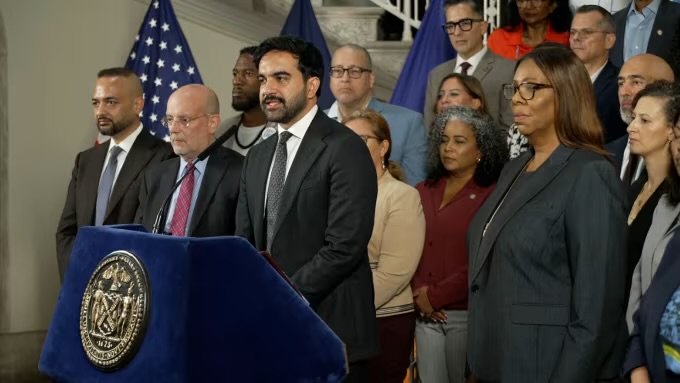
New York Attorney General Letitia James and New York City Mayor Zohran Mamdani announced the legal challenge during a news conference at Manhattan City Hall.
James argued that the expanded rule could discourage immigrants from accessing essential services for fear that doing so could affect their immigration status.
“The rule would allow immigration officers to consider use of critical benefits like Medicaid and SNAP, and even participation in school meal programs, as part of an applicant’s circumstance,” James said.
She added that the policy could leave immigrants facing difficult choices over whether to seek healthcare or food assistance.
“Will getting health insurance hurt my chances of getting a green card? Will accepting food assistance when I fall on hard times be held against me?” James asked.
The lawsuit argues that DHS exceeded its legal authority by broadening the definition of what may constitute a public charge. The states also described the rule as “arbitrary and capricious,” alleging that the federal government failed to properly justify the changes or assess their potential economic impact on state healthcare and welfare systems.
James strongly criticised the policy, saying, “Cruelty is the point (of the rule change). Having a chilling effect on immigrants is the point. Letting individuals know that they are not welcome here is the point. Immigration animus is the point.”
Mamdani similarly warned that immigration-related policy changes were already affecting participation in public benefit programmes, including among people who may not be directly covered by the new restrictions.
“We’re talking about something that we know categorically does not apply to certain sets of New Yorkers, and yet we’re already seeing evidence of those kinds of New Yorkers unenrolling from life-saving benefits,” he said.
The state lawsuit was filed alongside a separate legal action by several local governments, including Chicago, San Francisco, Seattle, Santa Clara County and King County. Both cases were brought before the U.S. District Court for the Southern District of New York.
The plaintiffs are asking the court to declare the DHS rule unlawful and prevent the federal government from implementing it.