
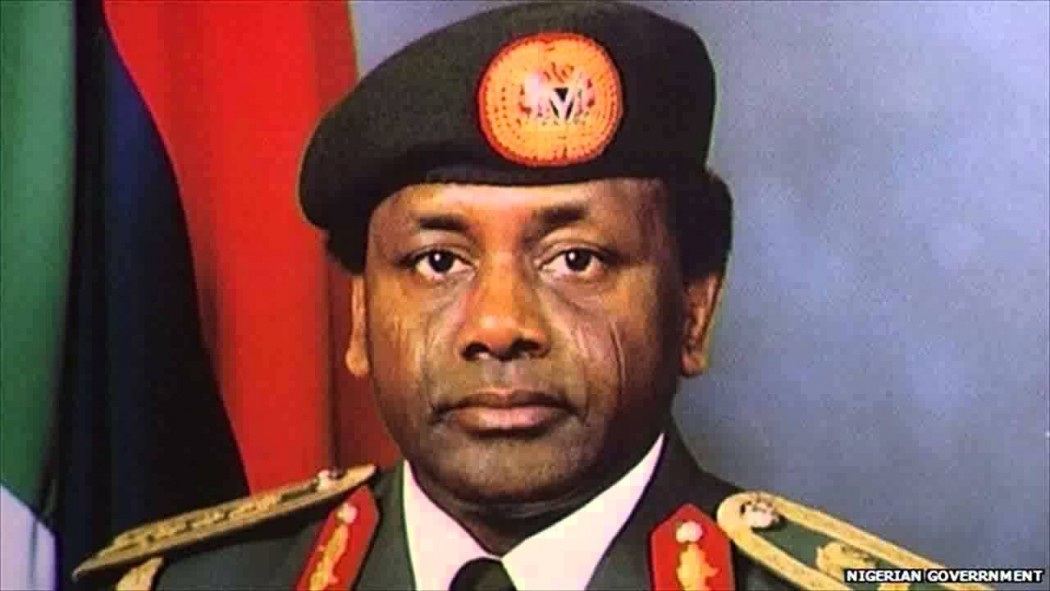
A former Assistant Director of the Department of State Services (DSS), Dennis Amachree, has provided a fresh account of the events surrounding the death of Nigeria’s former military Head of State, General Sani Abacha, nearly three decades after the incident.
Amachree, in his newly released book, DSS @40: My Journey Behind the Shield, recounted what he described as the sequence of events that led to Abacha’s death on June 8, 1998, while the military leader was still in office.
According to the retired intelligence officer, he was serving as the Assistant Director of Operations and Intelligence at the Lagos Command of the then State Security Service when news of Abacha’s death broke.
He claimed that a woman identified as Abacha’s girlfriend arrived at the Aso Rock Guest House in Abuja at about 2:40 a.m. after the departure of then Chief of Army Staff, General Jeremiah Useni.
“At approximately 2.40 am, shortly after Gen. Useni left, Abacha’s girlfriend, an Igbo lady, arrived at the Aso Rock Guest House from the Nicon Noga Hilton Hotel,” Amachree wrote.
He further disclosed that the woman had arrived with her younger sister, a pharmacist who was attending a professional conference in Abuja. According to him, the younger sister was later left alone with the military ruler after the elder sibling returned to the hotel.
Amachree stated that around 4:05 a.m., the pharmacist realised Abacha had become unresponsive and could no longer detect a pulse.
The retired DSS officer explained that the frightened woman immediately left the guest house and informed the soldier on duty that Abacha had requested a vehicle to take her back to the hotel.
“The soldier, unaware of the gravity of the situation, promptly arranged for her transportation,” he stated.
According to Amachree, the pharmacist later informed her sister of what had happened before arrangements were made for her to board an early morning flight to Lagos.
He said security operatives later moved to arrest the woman after Abacha’s aides discovered the former Head of State had died, but by then she had already departed Abuja.
“The State Security Service was immediately informed and went to the Hilton to arrest the girlfriend, but the pharmacist they urgently needed was already on her way to Lagos,” he wrote.
Amachree said he subsequently received instructions from the DSS headquarters to track down the woman in Lagos.
“My team located and brought her to my office. I interrogated her myself,” he recalled.
According to him, the woman immediately denied any wrongdoing during the interrogation.
“The first thing she said to me was, ‘I did not kill him; he died on top of me,'” Amachree quoted her as saying.
He noted that after providing her account of the incident, the woman was flown back to Abuja.
The former DSS official maintained that the woman’s testimony contradicts many of the stories that have circulated over the years regarding Abacha’s death, including claims involving foreign women or poisoning.
Instead, he argued that the account points to a sudden cardiac emergency.
“The lady pharmacist’s account, on whom Abacha apparently had a coitus-induced cardiac arrest, remains the true position and puts an end to the conspiracy theories and half-truths that have gone viral,” Amachree stated.
However, the account represents Amachree’s personal recollection as contained in his book and has not been independently verified.
General Sani Abacha ruled Nigeria from November 1993 until his death on June 8, 1998. His passing paved the way for a political transition that eventually culminated in the return of democratic rule in 1999. About a month after Abacha’s death, detained pro-democracy figure Moshood Kashimawo Olawale (MKO) Abiola, widely regarded as the winner of the annulled June 12, 1993 presidential election, also died in custody.