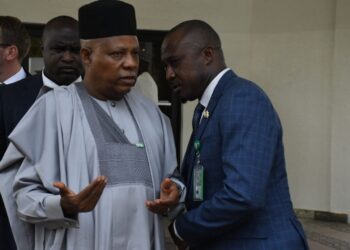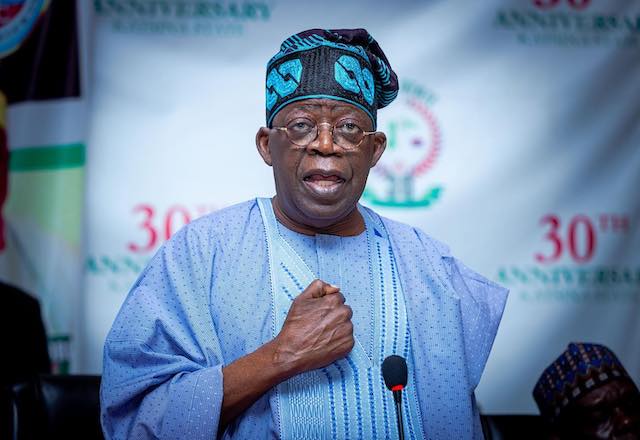


President Bola Ahmed Tinubu’s renomination of Senator Kashim Shettima, as his running mate deserves wide accolades and has been described as a thoughtful affirmation of political stability, administrative continuity, and purposeful governance.
In an era where political expediency often overshadows institutional consistency, the decision reflects strategic wisdom and confidence in a tested partnership that has steadily evolved into one of mutual loyalty, trust, and shared commitment to Nigeria’s progress.
Coming on the heels of recent sustained agitations by some political interests, both within and outside the All Progressives Congress (APC), calling for the replacement of Vice President Shettima, the President has by endorsing his Vice President for a second term in office confirmed himself as a political strategist and rewarder of loyalism; a scarce commodity in the present political dispensation. Rather than yield to transient political pressures, President Tinubu has demonstrated that leadership should be guided by competence, performance and trust rather than by the noise of political speculators. Such consistency is not only healthy for the ruling party but also reassuring for the nation’s democratic stability.
Throughout political history, successful administrations have often been defined not merely by the brilliance of individual leaders but by the strength of the partnerships they cultivate. Great governments are built upon confidence, shared vision and complementary leadership. President Tinubu’s confidence in Senator Shettima therefore represents more than a political calculation; it is a reaffirmation of the value of teamwork in governance.
Senator Kashim Shettima’s remarkable journey to the national political platform illustrates the enduring virtues of education, diligence, resilience, and public service. Born on September 2, 1966, in Maiduguri, Borno State, into the respected family of Alhaji Shettima Mustafa Kuttayibe and Hajja Nana Kujarima Shettima of the distinguished El-Kanemi royal lineage, VP Shettima’s story resonates with many as one of humble beginnings. A former banker, the Vice President’s transition into public service in 2007 brought those administrative skills into governance. Serving successively as Commissioner for Finance and Economic Development, Local Government and Chieftaincy Affairs, Education, Agriculture and Health in Borno State, Shettima acquired broad executive experience before emerging as Governor of Borno State in 2011.
Building on his numerous achievements as a two-term Governor, Shettima’s foray into federal politics saw him emerge as Senator in 2019 and subsequently led to his nomination as President Tinubu’s running mate in the 2023 presidential election; a new national responsibility. In spite of public controversy over a Muslim-Muslim ticket which dogged the Tinubu-Shettima presidential ticket given Nigeria’s political experience dictated by ethno-religious sentiments in the nation’s political history, the Presidency of Tinubu has proved many cynics virtually wrong.
One of the defining attributes of the Vice President since assumption of has been his readiness to represent Nigeria and President Tinubu with distinction on the global stage. He has led high-level Nigerian delegations to international engagements, including representing the President at successive sessions of the United Nations General Assembly and participating in the BRICS Summit in South Africa in 2023, among several other strategic diplomatic engagements. His eloquence, intellectual depth and grasp of national issues have consistently projected Nigeria positively before the international community. Within the Presidency, Vice President Shettima has equally assumed critical responsibilities that directly support the implementation of President Tinubu’s Renewed Hope Agenda. He has driven initiatives across agriculture, nutrition, digital jobs, MSME development, skills acquisition, flood response coordination, and other socio-economic interventions aimed at improving the welfare of Nigerians.
Of particular constitutional significance is his leadership of the National Economic Council (NEC), where meaningful deliberations have advanced several important national initiatives, including broad support from state governors for the State Police initiative championed by President Tinubu as part of wider security sector reforms. Such responsibilities underscore the enormous confidence reposed in him by the President and the practical value he continues to add to governance.
Perhaps even more remarkable than his impressive résumé is his unwavering loyalty to President Tinubu. In democratic governance, loyalty should never be mistaken for servility. Rather, it represents disciplined commitment to collective purpose while providing dependable support to the elected leader, Senator Shettima has exemplified this delicate balance with admirable maturity. His loyalty has strengthened, rather than diminished, institutional governance.
Indeed, history will likely remember him as one of the most loyal and committed Vice Presidents in Nigeria’s democratic journey. His humility, exceptional communication skills, intellectual disposition and ability to build bridges across ethnic, religious and political divides have enhanced the image of the administration while reinforcing national cohesion. A detribalised Nigerian, accomplished former banker and experienced administrator, Shettima possesses qualities that remain indispensable in contemporary governance.
Having had the privilege of observing His Excellency, Senator Kashim Shettima, at close quarters and working with him, I have witnessed firsthand his uncommon work ethic, intellectual curiosity, humility and unwavering commitment to the success of President Tinubu’s administration. Behind the public persona is a disciplined leader who prepares meticulously, listens attentively, values teamwork, and approaches governance with uncommon seriousness of purpose.
President Tinubu’s decision to retain Senator Shettima therefore transcends politics. It reflects an appreciation of competence, institutional memory and the value of tested partnerships. Effective governance flourishes where there is trust between principal and deputy, consistency in policy execution and continuity in leadership. Except for the President Jonathan – Vice President Sambo partnership, the President Tinubu – Vice President Shettima ticket remains an exemplary pact for study for political scholars and researchers.
As Nigeria looks towards another chapter of democratic consolidation, there is every reason to believe that Senator Kashim Shettima will continue to add immense value to President Tinubu’s administration in a second term beginning in 2027. His experience, loyalty, administrative capacity and commitment to the Renewed Hope Agenda position him to remain a dependable partner in the collective quest to transform Nigeria into a more prosperous, secure and united nation.
President Tinubu has once again demonstrated that enduring leadership is not built upon constant experimentation but upon recognising dependable talent, rewarding loyalty and preserving effective partnerships. In retaining Senator Kashim Shettima, he has chosen continuity over uncertainty, experience over speculation and national interest over political convenience. It is a decision that deserves commendation.