
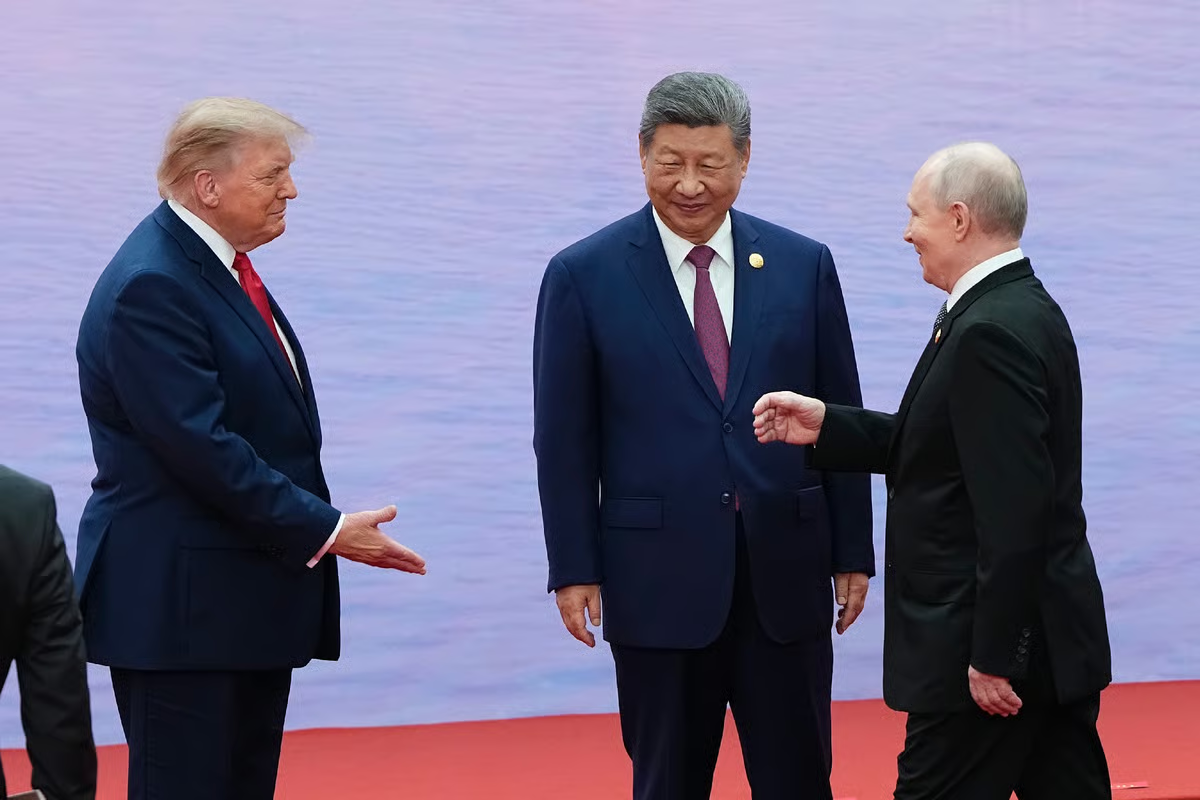
Chinese President Xi Jinping, United States President Donald Trump and Russian President Vladimir Putin have met in Shenzhen ahead of their first formal trilateral summit scheduled for Thursday, November 19.
The three leaders exchanged pleasantries on Wednesday during a welcome dinner organised ahead of the Asia-Pacific Economic Cooperation (APEC) summit. They later joined other world leaders for a group photograph.
Trump received a high-profile welcome from Xi upon arriving in Shenzhen, with the Chinese leader personally receiving him at the airport.
The reception featured the national anthems of China and the United States, a military flypast and crowds waving the flags of both countries.
Xi’s decision to personally welcome Trump was particularly significant, marking the first time in decades that a Chinese paramount leader had received a foreign leader upon arrival. The gesture also reflected Trump’s reception of Xi at Joint Base Andrews in September.
The proposed trilateral meeting has generated considerable international interest, particularly amid concerns that the three global powers could reach an understanding on dividing influence across different regions of the world.
Although the full agenda has not been made public, the United States has indicated that discussions could include the conflict involving Iran, nuclear disarmament and the ongoing war in Ukraine.
Trump initially suggested that the Ukraine conflict would not be discussed but later confirmed that the issue would feature in the talks.
The meeting comes as Russia continues to face Western sanctions imposed following its 2022 invasion of Ukraine. However, Putin dismissed the effectiveness of the measures while addressing the APEC gathering on Wednesday, describing them as having “failed”.
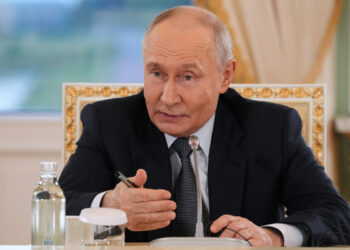
The Russian president also welcomed the planned meeting with Xi and Trump, describing it as “highly useful” and calling for stronger international cooperation.
“At a time when military-political risks are on the rise, what is desperately needed is unity rather than division… and dialogue rather than ultimatums,” Putin said.
However, Canada’s Prime Minister, Mark Carney, maintained that pressure on Moscow would continue, declaring that sanctions against Russia would “continue to increase as long as this war goes on”.
Ukraine’s Foreign Minister, Andriy Sybiga, also expressed hope that the discussions between Xi and Trump would lead to increased pressure on Moscow to end the conflict.
He said he hoped both leaders would put “pressure on Russia to end the war”.
Meanwhile, Xi and Putin held their fifth bilateral meeting of the year, including one conducted through a video link. During the discussion, the Chinese president called for closer cooperation between Beijing and Moscow.
Xi urged both countries to “leverage the mechanisms for exchanges between the two countries’ governments, legislative bodies, militaries and political parties”.
Trump arrived in China from the Philippines, where he attended an Association of Southeast Asian Nations summit and held discussions with leaders of the Quad, a strategic grouping comprising Australia, Japan and India.
The US president has also indicated interest in meeting North Korean leader Kim Jong Un during his visit, claiming that Kim “would like” to meet him. However, Pyongyang has yet to confirm whether such a meeting will take place.
Economic relations between Washington and Beijing are also expected to feature prominently in the discussions, particularly following Trump’s tariff measures and the growing competition between the two countries.
Chinese Premier Li Qiang criticised what he described as a “countercurrent of unilateralism and protectionism” on Monday, while highlighting China’s expanding trade relations with ASEAN countries.
Trump, on his part, said on Tuesday that the United States would catch up with China in rare-earth production “within 10 months”.
The outcome of Thursday’s proposed summit is expected to attract global attention, given the influence of the three countries on international security, trade, diplomacy and the ongoing conflicts shaping global affairs.