
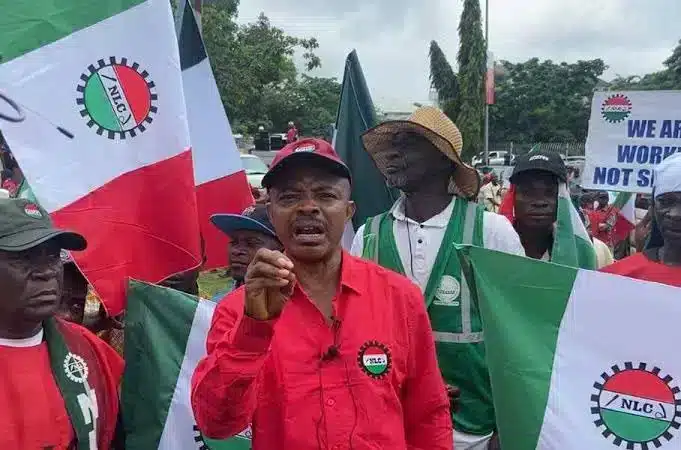
The President of the Nigeria Labour Congress (NLC), Joe Ajaero, has accused unnamed individuals and groups of plotting to weaken organised labour ahead of negotiations for a new national minimum wage.
Ajaero alleged that those behind the move were deploying rumours, exploiting disagreements among trade unions and creating divisions among workers to undermine the collective bargaining strength of the labour movement.
He warned that the alleged plot was designed to frustrate negotiations and deny Nigerian workers the decent wages they deserved.
The NLC president raised the concern while speaking at the 22nd edition of the Congress’ Annual Harmattan School 2026, themed ‘Organising in the Context of Socio-Economic Transformation’.
According to Ajaero, the labour movement must remain united and vigilant as preparations begin for another round of minimum wage negotiations.
He said, “As we prepare to negotiate a new national minimum wage, we want to draw your attention to the fact that the enemies of the labour movement are already at work. Their strategy is as old as it is dangerous: divide us, weaken our resolve and sabotage upcoming national minimum wage negotiations before they even begin.”
He further alleged that the strategy involved deliberately creating mistrust among unions and individual workers.
“They will spread rumours, exploit our differences and seek to set one union against another, one worker against another. However, we must see this plan for what it is, an attempt to rob Nigerian workers of the decent wage they deserve,” he added.
Ajaero urged labour leaders and union members to resist attempts to create divisions within their ranks, stressing that unity would be crucial to securing improved wages and better working conditions.
He also called on the Federal Government to implement the agreement reached with organised labour on October 27, 2026, particularly the provisions relating to the N70,000 transport allowance and the establishment of a tripartite standing wage review committee.
The labour leader insisted that agreements reached between the government and workers’ representatives must be respected and implemented without political considerations.
“Agreements cannot become matters of convenience that are respected only when politically convenient,” Ajaero declared.
He expressed concern over the economic difficulties facing Nigerian workers, noting that the rising costs of food, transportation, housing, healthcare and education had continued to put pressure on household incomes.
According to him, discussions about workers’ welfare should go beyond the amount reflected in their monthly salaries to consider whether their earnings can adequately meet their basic needs.
“The question before us, therefore, is not only simply how much workers take, but whether workers can live decently from their earnings,” he said.
Beyond wage negotiations, Ajaero urged Nigerian workers to become more politically active ahead of the 2027 general elections.
He called on labour unions to demand issue-based campaigns from political parties and presidential candidates, insisting that election promises must address the country’s most pressing economic and social challenges.
“As we approach the 2027 general election, we must insist that campaigns should be issue-based, not a contest of sentimentality, slogans, petty calculations or empty promises,” he stated.
He identified unemployment, workers’ wages, healthcare, education, insecurity, food production, infrastructure and general workers’ welfare as critical issues that should dominate political discussions.
Ajaero also urged the Independent National Electoral Commission (INEC) to ensure transparency in voter registration and other electoral activities to strengthen public confidence in the electoral process.
He maintained that Nigerian workers must carefully examine the programmes of political candidates and hold elected officials accountable for their promises.
The NLC president’s remarks come amid growing concerns over the rising cost of living and the purchasing power of Nigerian workers, with organised labour pushing for improved wages and the full implementation of agreements reached with the Federal Government.