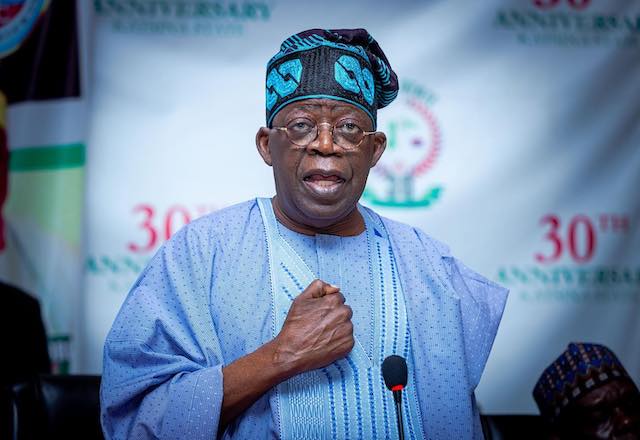


President Bola Ahmed Tinubu has asked a United States federal court to reject a request for the release of additional records held by the Federal Bureau of Investigation (FBI) and the Drug Enforcement Administration (DEA) concerning him.
Tinubu, through his legal team, urged the US District Court for the District of Columbia to uphold the redactions and withholding of information contained in records sought by American transparency activist and researcher Aaron Greenspan.
The request was contained in an amended filing submitted on October 1, 2026, in the case of Aaron Greenspan v. Executive Office for U.S. Attorneys et al., Civil Action No. 23-1816 (BAH).
Greenspan is seeking records under the US Freedom of Information Act (FOIA) relating to Tinubu and other individuals in connection with federal investigations dating back to the late 1980s and early 1990s.
Tinubu has denied any wrongdoing.
According to the court filing, the FBI and DEA have already released thousands of documents in response to the requests, although some portions were redacted. The DEA also provided a Vaughn index detailing records or portions of records withheld under specific legal exemptions.
Greenspan, however, has challenged the extent of the disclosure and asked the court to grant summary judgment in his favour.
The filing stated that Greenspan claimed he could not recall seeing the word “Tinubu” on any page of the documents released by the government.
Tinubu’s lawyers countered that FOIA is primarily intended to provide the public with information about government activities and is not designed to expose private information about individuals merely because such information is held by government agencies.
They cited a 1989 US Supreme Court decision and argued that disclosure of records concerning private citizens could reveal “little or nothing about an agency’s own conduct.”
The legal team further argued that the remaining information requested by Greenspan is protected under FOIA Exemption 7(C), which permits the withholding of certain law-enforcement records where disclosure could constitute an unwarranted invasion of personal privacy.
They also invoked the US Privacy Act as an additional legal basis for withholding or redacting personal information.
“The DEA and FBI properly redacted or withheld exempt information from the responses to the requests,” Tinubu’s lawyers told the court.
The filing also addressed an earlier dispute over the use of a “Glomar response”, a mechanism that allows a government agency to refuse to confirm or deny whether particular records exist when doing so could expose protected information.
In an April 2025 ruling, US District Judge Beryl Howell held that the FBI and DEA could not rely on Glomar responses in the circumstances before the court and directed the agencies to search for and process records that were not exempt from disclosure.
Tinubu’s lawyers, however, argued that the ruling did not require every piece of information contained in responsive investigative files to be released.
They maintained that the court had distinguished between Tinubu’s privacy interest in the contents of investigative records and whether authorities had investigated him.
The lawyers also rejected Greenspan’s argument that information connected to a 1993 forfeiture proceeding was already in the public domain.
“Other than by speculation or labels, Plaintiff does not point to an existing public record that contains details of a governmental criminal investigation or findings about Intervenor,” they argued.
The legal team further maintained that the fact that some information about an individual may have previously become public does not automatically remove privacy protections over other information that has never been disclosed.
They also argued that Tinubu’s status as Nigeria’s president does not eliminate his privacy rights concerning events that occurred decades before he assumed office.
“Intervenor was not President of Nigeria in 1993,” the amended filing stated.
According to the lawyers, the records being sought concern events from approximately 1988 to 1991, and Tinubu’s subsequent election as president should not diminish his privacy interests in those records.
They further argued that Greenspan had not provided sufficient evidence of government wrongdoing to override the privacy protections provided by law.
Tinubu’s legal team consequently asked the court to reject Greenspan’s motion for summary judgment and permit the FBI and DEA to maintain their existing redactions and withholdings.