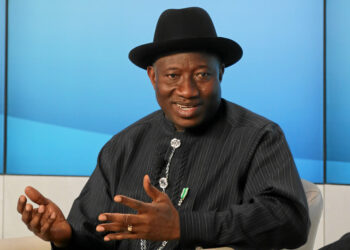


Former President Goodluck Jonathan has called on Nigerian politicians to prioritise national interest over party allegiance and sectional considerations, warning that ethnic, religious and regional divisions remain major obstacles to the country’s political development.
Jonathan made the appeal on Tuesday at the fifth National Conference of the Forum of Former Deputy Governors of Nigeria in Abuja, where he emphasised the importance of national unity, effective governance and strong democratic institutions.
Represented at the event by former Adamawa State Deputy Governor Bala Ngilari, the former president urged political leaders to promote competence, integrity and inclusiveness in their approach to public service.
He identified identity-based politics as a major challenge to Nigeria’s progress, calling on politicians to move beyond differences that continue to divide the country.
“One major obstacle to Nigeria’s political development is division along ethnic, religious and regional lines. We must rise above these differences and promote politics founded on competence, integrity, inclusion and national interest,” Jonathan said.
He further stressed that the country’s collective interests must take precedence over the ambitions of political parties and individuals.
“Nigeria must always be greater than any political party, individual or sectional interest,” he stated.
Jonathan, who previously served as deputy governor and governor of Bayelsa State before becoming vice-president and later president, said his years in public office had taught him the importance of consultation, collaboration and building institutions capable of sustaining democratic governance.
He urged former deputy governors to maintain constructive relationships with serving governors, support emerging political leaders through mentorship and discourage practices that promote division.
The former president also reminded former political office holders that public positions were temporary, but the consequences of their decisions could affect future generations.
He encouraged them to use their experience to guide younger politicians towards responsible leadership, accountability and integrity.
While expressing confidence in Nigeria’s prospects, Jonathan pointed to the resilience and creativity of the country’s population, particularly its young people.
He, however, said the government must create an environment where young Nigerians could find employment, develop innovative ideas and achieve economic prosperity.
Meanwhile, former Kano State Governor and immediate past National Chairman of the All Progressives Congress (APC), Abdullahi Ganduje, called for greater national cohesion, urging Nigerians to view the country’s diversity as a source of strength rather than division.
Ganduje examined the historical roots of Nigeria’s national integration challenges, noting that although nationalist leaders played important roles in the country’s independence struggle, some political movements later became increasingly associated with ethnic interests.
He said the emergence of parties organised largely along ethnic lines after independence contributed to the difficulties Nigeria has faced in building a shared national identity.
The former governor urged political leaders and citizens to draw lessons from the country’s history and work towards a stronger sense of national belonging.
He also raised concerns about the state of democratic institutions, particularly the judiciary, questioning how meaningful reforms could be achieved to strengthen their effectiveness and public confidence.
Ganduje further criticised the lack of continuity between successive administrations, explaining that disagreements between outgoing and incoming governors often resulted in the abandonment or reversal of ongoing projects.
According to him, such situations sometimes occur even when the administrations involved belong to the same political party, creating setbacks for development and public service delivery.
He also called for greater appreciation of the role played by deputy governors in state administration, arguing that their contributions to governance should not be overlooked.
In a separate address, former Delta State Governor Ifeanyi Okowa expressed concern over the widening gap between government policies and the everyday realities of Nigerians.
Okowa said the disconnect had contributed to declining public confidence in government, stressing that effective nation-building required a renewed commitment to accountability, inclusion and collective responsibility.
He noted that many citizens felt disconnected from governance because their expectations and aspirations were not being adequately addressed.
The former governor maintained that rebuilding public trust would require governments to ensure that policies translate into tangible improvements in people’s lives.
The conference brought together former deputy governors and other political stakeholders to discuss governance, democratic development and the challenges confronting Nigeria’s political system.