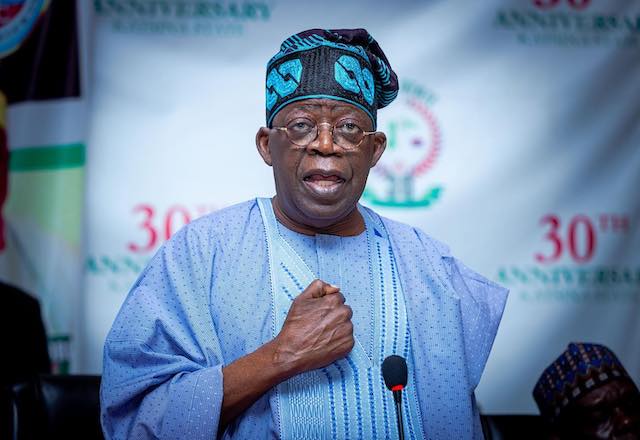

President Bola Ahmed Tinubu has asked a United States federal court to reject a request seeking the release of records concerning him held by the Federal Bureau of Investigation (FBI) and the Drug Enforcement Administration (DEA).
Tinubu’s position was contained in court filings submitted by his legal team comprising Christopher Carmichael, Victor Henderson and Oluwole Afolabi before the United States District Court for the District of Columbia.
The filings were made in response to a Freedom of Information Act (FOIA) request by American transparency activist Aaron Greenspan, who is seeking access to documents bearing Tinubu’s name.
The President’s lawyers advanced four major arguments against the disclosure of the records, maintaining that US privacy laws protect the information and that the request does not meet the public-interest standard required under FOIA.
Tinubu cites privacy protections
According to the court filings, Tinubu argued that both the US Freedom of Information Act and the Privacy Act restrict the release of the records sought by Greenspan.
His legal team maintained that the information contained in the requested documents falls under privacy exemptions applicable to law-enforcement records.
“The redacted information sought by the plaintiff is exempt from disclosure,” the lawyers argued, citing Exemption 7(C) of FOIA, which protects personal information contained in law-enforcement records.
The lawyers also argued that the request did not establish a sufficient public interest capable of outweighing the privacy interests involved.
Lawyers reject Nigeria-related public interest argument
Greenspan had argued that his request was justified by Tinubu’s position as the sitting President of Nigeria and the impact of his decisions on millions of Nigerians.
According to the filings, Greenspan maintained that the request concerned the “sitting President of Nigeria” and a country of more than 230 million people whose citizens are directly affected by Tinubu’s decisions.
However, Tinubu’s lawyers rejected that argument, saying the interest of Nigerians in the President’s personal background does not constitute the type of public interest recognised under US FOIA law.
The legal team also disputed the claim that the records could be justified by questions surrounding Tinubu’s fitness for office.
“The asserted ‘public interest in Tinubu’s own fitness for office’ is not an interest FOIA recognises or one that needs to be balanced,” the lawyers stated.
Tinubu alleges political motive
The President’s legal team further argued that Greenspan’s request appeared to have an ulterior purpose, describing it as an attempt to obtain private information for political purposes in Nigeria.
The lawyers urged the court to reject the request on the grounds that it was seeking personal information rather than records that would shed light on the activities or conduct of the US government.
They relied on a 1989 US Supreme Court ruling, Department of Justice v. Reporters Committee for Freedom of the Press, to support their interpretation of the purpose of FOIA.
According to the legal team, the Supreme Court established that FOIA is primarily concerned with allowing the public to understand “what the government is up to”, rather than providing access to private information about individuals contained in government files.
The lawyers argued that Greenspan’s request amounted to seeking the disclosure of information about private citizens collected in government records.
They said such disclosure, in their view, “reveals little or nothing about an agency’s own conduct.”
Court asked to dismiss request
Tinubu’s lawyers therefore urged the US District Court for the District of Columbia to decline Greenspan’s request for the FBI and DEA records.
Their argument rests largely on the position that the documents contain protected personal information, that no qualifying public interest has been established under US law, and that the request is motivated by political interests rather than scrutiny of US government conduct.
The court will determine whether the requested records can be withheld under the privacy protections and exemptions cited by the President’s legal team.