

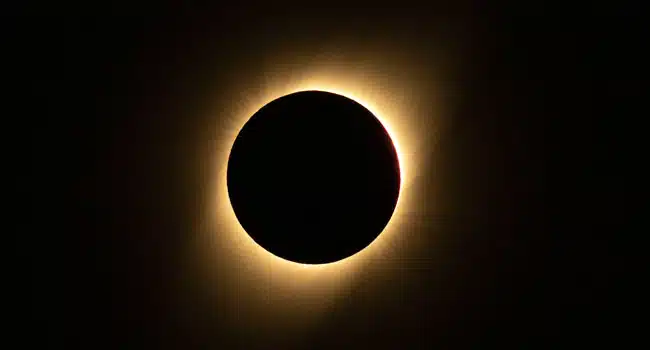
Residents and visitors across parts of northern Spain are set to witness a rare celestial event on August 12 as a total solar eclipse sweeps across the region, marking the first total solar eclipse visible from mainland Europe since 2006.
A total solar eclipse occurs when the Moon passes directly between the Earth and the Sun, completely blocking the Sun’s light and casting a narrow shadow over parts of the planet. During the brief period of totality, daylight gives way to twilight, temperatures may drop, shadows can appear distorted, and some animals may behave as though night has fallen.
According to the U.S. National Aeronautics and Space Administration (NASA), the phenomenon is made possible by a remarkable alignment of the Sun and the Moon.
“Although the Sun is about 400 times larger than the Moon, it is also roughly 400 times farther away, making both appear nearly the same size from Earth,” NASA explained. “This allows the Moon to completely block the Sun, revealing its outer atmosphere, known as the corona.”
The eclipse will begin over a remote part of northern Russia before its path of totality stretches across Greenland, Iceland, Spain and the northeastern tip of Portugal.
In Spain, the eclipse will trace a path from the northern city of Oviedo to the Mediterranean island of Mallorca, where observers are expected to experience less than two minutes of total darkness shortly before sunset.
In Burgos, totality is forecast to last one minute and 48 seconds. Although slightly longer periods of totality are expected in parts of Russia and Greenland, the event will remain under two-and-a-half minutes across its entire path.
Before and after totality, a partial solar eclipse will be visible for approximately one hour and 45 minutes. Partial phases of the eclipse will also be seen across much of Europe, Canada, the northern United States and northwest Africa.
Astronomers note that while one or two solar eclipses occur somewhere on Earth every year, total eclipses are uncommon for any single location because the Moon’s shadow covers only a narrow strip of the Earth’s surface. As a result, some regions can go centuries without witnessing one.
Spain, however, is expected to enjoy another major eclipse soon. On August 2, 2027, a total solar eclipse will cross southern Spain, northern Africa and the Arabian Peninsula.
The event has been described by some astronomers as the “eclipse of the century” because totality is expected to last up to six minutes and 23 seconds, making it the longest total solar eclipse of the 21st century.
The country is also scheduled to witness an annular, or “ring of fire,” solar eclipse on January 26, 2028, when the Moon will cover the centre of the Sun while leaving a bright ring of sunlight visible around its edges.
Meanwhile, experts have urged the public to observe the eclipse safely, warning that looking directly at the Sun without certified eye protection can cause permanent eye damage.
They recommend using eclipse glasses that meet the ISO 12312-2:2015 international safety standard.
Health experts further warned that eye damage may not be immediately noticeable because the eyes lack pain receptors.
Research conducted following the 2024 total solar eclipse in the United States also recorded a sharp rise in online searches for the phrase “my eyes hurt,” underscoring the importance of proper eye protection during such events.