
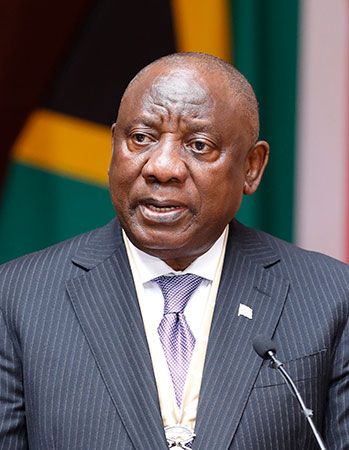
South African President Cyril Ramaphosa has condemned recent violent protests and criminal attacks targeting foreign nationals in parts of the country, insisting that no individual or group has the authority to enforce immigration laws outside the legal framework.
In his weekly newsletter to the nation on Monday, Ramaphosa said the attacks on foreign nationals did not reflect the values of South Africans or the position of his government.
“Dear Fellow South African, the recent violent protests and criminal acts directed at foreign nationals in parts of our country do not represent the views of South Africa’s people nor reflect our government’s policy,” the president stated.
He described those behind the unrest as “opportunists” who were taking advantage of the frustrations of poor communities while pretending to act in the interest of local residents.
“These are the acts of opportunists who are exploiting the legitimate grievances, particularly those of the poor, under the false guise of ‘community activism’,” Ramaphosa said.
The South African leader warned that some individuals involved in the protests had begun carrying out duties reserved for law enforcement agencies.
“Some of these people are assuming functions that only state officials are permitted to perform, including stopping people to check identification and conducting searches of private property. Such lawlessness will not be tolerated, regardless of who the perpetrators or victims are,” he added.
Despite condemning xenophobic violence, Ramaphosa acknowledged growing concerns over undocumented migration, saying illegal immigration posed challenges to governance, security and public services.
“At the same time, as a society, we need to deal decisively – and within the law – with the challenge of illegal immigration, which risks our social stability, governance and national security,” he said.
According to him, undocumented migration has increased pressure on healthcare, housing and municipal services, especially in poorer communities, while also affecting employment opportunities for citizens.
“In a country with high unemployment, some employers are exploiting undocumented, cheaper foreign labour over hiring citizens and paying them legal wages,” Ramaphosa stated.
“Not only is this fuelling social tension, it is actively undermining our labour protection regime and eroding the hard-won rights of workers.”
The president said the government was strengthening border security and immigration enforcement measures through the Border Management Authority and security agencies.
He revealed that authorities intercepted approximately 450,000 individuals attempting to enter South Africa illegally during the last financial year.
“We commend the BMA for successfully intercepting some 450,000 people trying to enter South Africa illegally in the past financial year,” he said.
Ramaphosa also reiterated plans announced during his State of the Nation Address to recruit up to 10,000 labour inspectors to ensure compliance with labour and immigration laws, particularly among employers hiring undocumented migrants.
“We are stepping up workplace enforcement against employers who hire undocumented foreign nationals in violation of labour and immigration laws,” he noted.
The president further warned South Africans against aiding illegal activities linked to undocumented migration, including fake marriages, corruption and the unlawful sale of government-subsidised housing.
“South African citizens who collude with undocumented foreign nationals in fake marriages, the illegal sale of state-subsidised housing or accepting bribes to facilitate access to social services only deepen the problem,” he said.
Ramaphosa stressed that South Africa remained committed to African unity, regional integration and human rights, adding that isolated incidents of criminality should not damage the country’s international reputation.
“We must make it clear that there is no place in South Africa for xenophobia, ethnic mobilisation, intolerance or violence,” the president declared.
“Everyone in South Africa is bound by the same laws and we are committed to ensure that they are respected and upheld by citizen and foreign national alike.”