
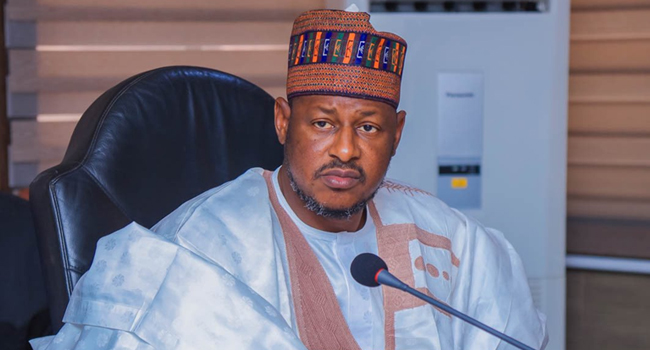
Governor of Katsina State, Dikko Radda, has alleged that informants within government institutions, security agencies and local communities are sabotaging efforts to tackle insecurity by leaking intelligence to bandits.
Speaking during an interview with Channels Television, Radda said criminal groups operating in the state often receive advance notice of security operations, making it difficult for authorities to apprehend them.
The governor specifically identified a notorious bandit known as Mohammed, claiming the suspect has continued to evade arrest due to insider information from collaborators.
“This notorious person that is disturbing us, we know him. He is Mohammed; that is his name. Everybody knows him. His father, his mother, and his grandfather were born there,” Radda said.
He accused some residents of communities affected by banditry of shielding the suspect and withholding critical intelligence from security agencies.
“The communities are not giving the right information. I can say that, in a way, some of them are helping him,” he stated.
Radda further alleged that confidential discussions from high-level security meetings were sometimes leaked to bandits within minutes.
“The day I called for a high-level security meeting here at the state government on how to operate and deal with the situation, five minutes after the meeting, he already knew what we had discussed,” the governor disclosed.
According to him, the leaks have enabled armed groups to escape security raids and even stage ambushes against security operatives responding to distress calls.
“And whenever there is information about an attack and security operatives move to the area, the moles within the community will call and inform him that security personnel are coming and which route they are taking, allowing them to lay ambushes for the security operatives,” he said.
“So, this is the kind of situation we are in. There are moles among us, moles among the security agencies, and moles among the communities.”
The governor also spoke on the controversial issue of negotiating with bandits, explaining that although he initially opposed dialogue, he later permitted some communities to engage armed groups after repeated appeals from residents seeking peace.
“I was the one who initially took the position against negotiating with bandits. But when the situation became unbearable, the communities approached me and said, ‘Your Excellency, we have met with these people, they are ready to lay down their arms,’” he said.
Radda noted that some local government areas that embraced peace talks had recorded significant improvements in security.
“As I speak with you today, there are some local governments that entered into peace negotiations with bandits, and for over a year, there have been no attacks in those places,” he stated.
“We now have peace in most of the local governments where these incidents used to occur.”
Despite the reported success of some negotiations, the governor maintained that he would not personally initiate talks with bandits, stressing that any engagement must come from a position of strength.
Radda said he would only consider negotiations if the armed groups genuinely demonstrated readiness to abandon violence and embrace peace.