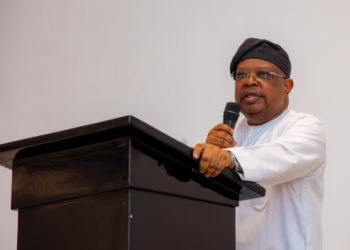

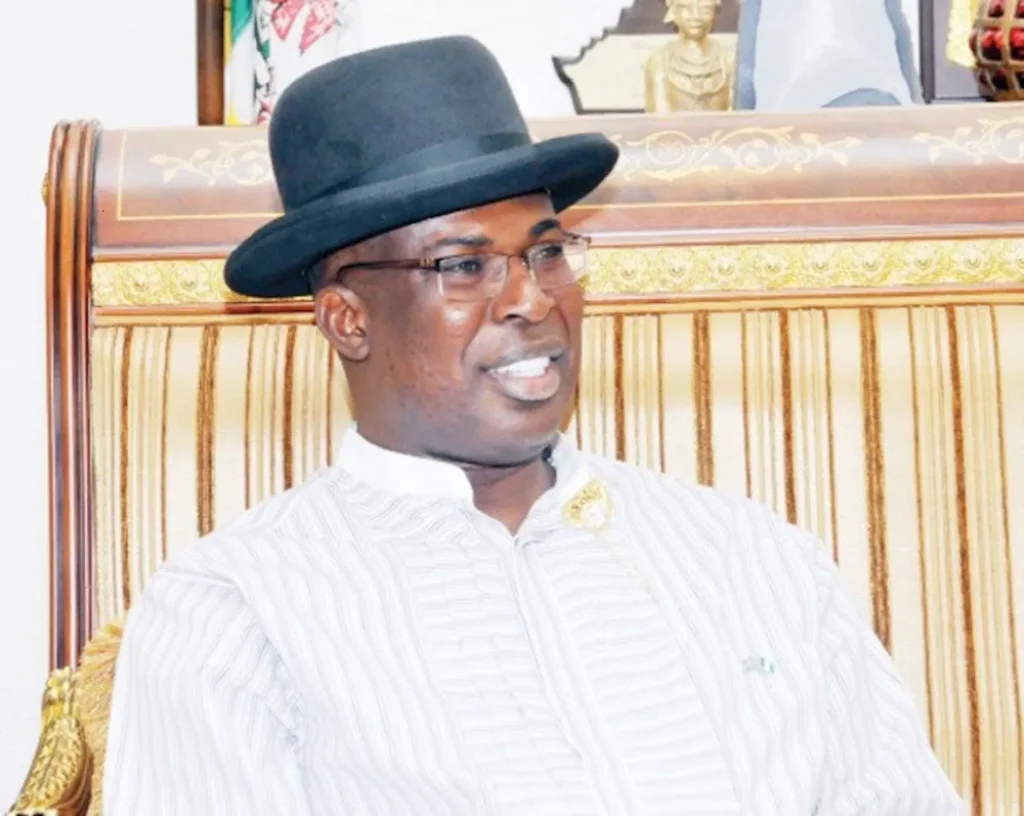
The media aide to former Minister of State for Petroleum Resources, Timipre Sylva, has denounced the Economic and Financial Crimes Commission’s decision to declare his principal wanted, describing it as a politically motivated witch-hunt by rivals threatened by the ex-minister’s influence.
Julius Bokoru, Special Assistant on Media and Public Affairs to Sylva, made the allegation in response to Monday’s announcement by the anti-graft agency, which declared the former minister wanted over alleged conspiracy and dishonest conversion of $14,859,257.
The EFCC, in a statement issued by its spokesperson Dele Oyewale, claimed the funds were part of investments made by the Nigerian Content Development and Monitoring Board into Atlantic International Refinery and Petrochemical Limited. The commission urged anyone with information about Sylva’s whereabouts to contact its offices or the nearest police station.
However, Bokoru fired back strongly, accusing the EFCC of operating in bad faith and issuing what he termed a “digital proclamation” aimed at turning public opinion against Sylva without following proper procedures.
According to the media aide, the former minister was never formally contacted through established channels before the agency went public with the wanted notice, raising questions about the commission’s motives and methods.
“It is, to say the least, curious that what was once whispered in corridors as a coup matter has now quietly metamorphosed into a financial allegation. No formal communication was extended to him, no established protocol observed, only a sudden digital proclamation designed, it would seem, to inflame public sentiment and manufacture yet another episode of orchestrated hostility,” Bokoru stated.
The aide suggested that the current allegations represent a tactical shift by political adversaries who previously attempted to implicate Sylva in connection with an alleged coup plot but are now repackaging their campaign as a financial crimes investigation.
“The same shadowy forces that once sought to criminalise Sylva politically now appear to have reinvented themselves as fiscal crusaders,” Bokoru said, implying that the EFCC may be serving as an instrument for settling political scores rather than pursuing genuine anti-corruption objectives.
He characterized the situation as part of a sustained campaign by political rivals who he claimed “dread Sylva’s enduring relevance and moral resolve,” suggesting that the former minister’s continued prominence in Nigerian politics has made him a target for those who see him as a threat.
Bokoru revealed that Sylva is currently in the United Kingdom receiving medical treatment but assured the public that the former minister would honor any formal invitation from the EFCC upon his return to Nigeria.
The media aide mounted a vigorous defense of his principal’s integrity, insisting that Sylva has maintained clean hands throughout his public service career and has never misappropriated public funds.
“Chief Timipre Sylva has clean hands. He has not diverted a single dollar, nor has he betrayed the trust reposed in him by the Nigerian people. The refinery project in question is a legitimate, transparent, and verifiable undertaking, subject to due process and traceable documentation,” Bokoru declared.
He called on Sylva’s supporters and well-wishers to remain calm and patient as the matter unfolds, expressing confidence that his principal would be vindicated once the facts are fully examined.
“Truth, though often delayed, remains immutable,” Bokoru stated, suggesting that time would prove Sylva’s innocence despite the current allegations.
The development adds another high-profile name to the list of former government officials facing corruption allegations from the EFCC under President Bola Tinubu’s administration, which has positioned the fight against corruption as a key priority.
Sylva served as Minister of State for Petroleum Resources under former President Muhammadu Buhari and was a key figure in Nigeria’s oil and gas sector during his tenure. He also previously served as governor of Bayelsa State before being removed from office following an election tribunal ruling.
The Atlantic International Refinery project referenced in the EFCC’s allegations has been a subject of interest as part of efforts to develop domestic refining capacity and reduce Nigeria’s dependence on imported petroleum products.
The Nigerian Content Development and Monitoring Board, established to increase local participation in the oil and gas industry, has made various investments aimed at building indigenous capacity in the sector, including support for refinery projects.
As the case develops, attention will focus on whether the EFCC follows formal procedures in engaging with Sylva upon his return from the United Kingdom, and whether the evidence the commission claims to possess can substantiate the serious allegations of conspiracy and fund diversion.
For now, the matter has become another flashpoint in Nigeria’s contentious anti-corruption landscape, where allegations of selective prosecution and weaponization of anti-graft agencies for political purposes continue to complicate public confidence in the fight against corruption.