
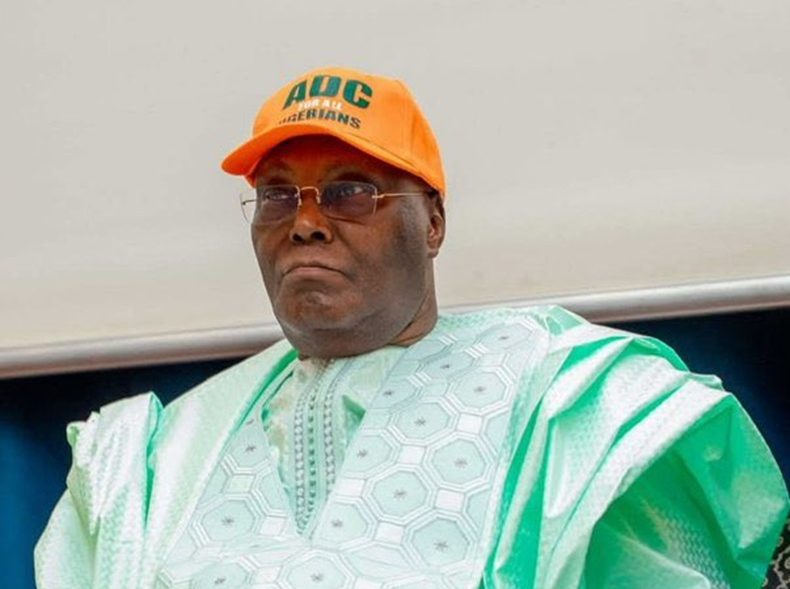
Former Vice-President Atiku Abubakar has criticised the Federal Government over the rising cost of energy in Nigeria’s manufacturing sector, warning that the development is worsening the prices of essential goods, particularly cement and other building materials.
Atiku argued that the increasing expenditure on electricity, diesel and gas by manufacturers was making production more expensive and putting affordable housing further beyond the reach of ordinary Nigerians.
The African Democratic Congress (ADC) presidential candidate made his position known in a statement issued on Thursday, November 26, by his Director of Strategic Communication, Phrank Shaibu.
He questioned how the government expected Nigerians to afford decent housing when manufacturers were spending huge amounts to generate electricity and keep their factories operational.
“You cannot build affordable homes with cement that families and builders can no longer afford. You cannot protect jobs while factories spend fortunes generating their own power. And you cannot restore purchasing power by calling hardship reform,” Atiku said.
Citing a report on the financial performance of manufacturing companies listed on the Nigerian Exchange, the former vice-president disclosed that 11 firms spent a combined ₦842 billion on energy between January and September 2026.
He noted that the figure represented a 7.4 per cent increase compared with the ₦784.08 billion recorded by the companies during the corresponding period in 2025.
According to Atiku, the rising energy expenditure was particularly affecting cement manufacturers, with the additional production costs eventually transferred to consumers.
“₦842 billion is the energy bill of only 11 companies in nine months. Cement manufacturers are among the industries hit hardest by the cost of power.
“That cost does not disappear at the factory gate. It enters the price of every bag of cement and pushes the cost of building a home further beyond the reach of ordinary Nigerians,” he stated.
He warned that manufacturers could be forced to increase product prices, reduce production, suspend expansion plans or lay off workers if the situation persisted.
Atiku also challenged the Federal Government’s claim that it had delivered more than 26,000 housing units, arguing that the figure included projects inherited from the administration of former President Muhammadu Buhari and housing units that were still under construction.
He called on the government to provide a detailed breakdown of the projects inherited, those completed under President Bola Tinubu and the number of Nigerians who had taken possession of the houses.
“A building site is not a completed home. An inherited project is not proof of fresh delivery. A mortgage approval is not a house key.
“Publish what Tinubu inherited, what his administration completed, how many families have moved in and what those homes cost,” he demanded.
The former vice-president also faulted claims by the All Progressives Congress (APC) Presidential Campaign Council that the Tinubu administration had created 525,100 jobs in the construction sector.
He maintained that estimated employment opportunities should not be presented as actual jobs already created.
As part of his proposed economic approach, Atiku said his Affordable Life campaign would prioritise reducing production costs through improved electricity supply to industries and a transparent, targeted subsidy for domestically refined fuel.
He stressed that Nigerians were more concerned about the rising costs of electricity, food, cement and rent than government announcements about projects and projected employment figures.
Atiku’s criticism followed a report by The Punch indicating that 11 manufacturing companies listed on the Nigerian Exchange spent ₦841.99 billion on energy in the first nine months of 2026.
The report further revealed that cement manufacturers accounted for 94.7 per cent of the total expenditure, with Dangote Cement and BUA Cement jointly spending ₦797.44 billion.
It also quoted the Director-General of the Manufacturers Association of Nigeria, Segun Ajayi-Kadir, as disclosing that manufacturers’ expenditure on self-generated electricity increased from less than ₦800 billion in 2023 to ₦1.1 trillion in 2024 and ₦1.35 trillion in 2025.