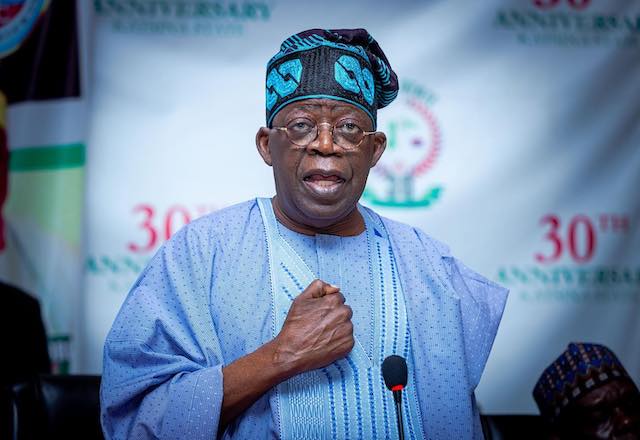

President Bola Tinubu has urged Nigerians to embrace tax payment as a civic responsibility necessary for national development, stressing that government cannot fund critical sectors without citizens contributing through taxes.
Speaking on Friday at the Africa CEO Forum in Kigali, Tinubu said many Nigerians demand improved infrastructure and public services while refusing to fulfil their tax obligations.
“Nobody wants to pay taxes. Yet everyone expects development. You want good roads and well-equipped hospitals, but you don’t want to contribute through taxes. The question is: how do we fund development and secure the future of our children?” the President said.
He added, “A citizen who pays tax is a citizen. If you are not paying taxes and not exempted, then you are not fulfilling your obligation.”
Tinubu also defended the economic reforms introduced by his administration, including the removal of fuel subsidy and the unification of the foreign exchange market, describing the measures as painful but necessary steps to rescue the economy from collapse.
According to him, Nigeria could no longer sustain a system that encouraged corruption, fuel smuggling and reckless spending.
“It was necessary to reset and reform the economy. We were spending future generations’ resources before they were born,” he stated.
Reflecting on the situation before the reforms were implemented, Tinubu said it was troubling that several states struggled to pay salaries despite the country’s oil wealth.
“You are producing oil, spending heavily on fuel subsidy, yet your refineries are not working. That trend was unsustainable,” he said.
The President acknowledged that the reforms initially caused hardship and attracted criticism from Nigerians, but maintained that early indicators showed the policies were beginning to yield positive results.
He noted that the naira had become more stable and predictable, creating a better environment for businesses and government planning.
Tinubu further disclosed that savings generated from the reforms had enabled the government to expand intervention programmes targeted at students and vulnerable households through educational support initiatives and direct assistance schemes.