
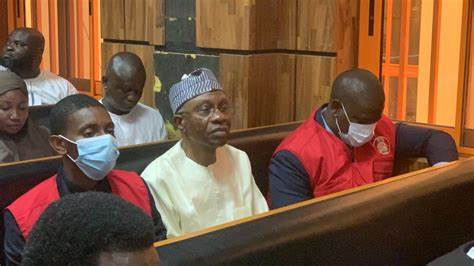
An investigator with the Economic and Financial Crimes Commission (EFCC) has told a Lagos State Special Offences Court how former Central Bank of Nigeria (CBN) Governor, Godwin Emefiele, allegedly acquired several properties across the country through intermediaries.
The investigator, Alvan Gurumnaan, who is the seventh prosecution witness in the trial, gave the account on Thursday while testifying before Justice Rahman Oshodi.
Gurumnaan alleged that investigations by the anti-graft agency uncovered properties in Lagos, Ogun, Delta State and Abuja whose combined value was far beyond Emefiele’s legitimate earnings as CBN governor.
He also told the court that the EFCC recovered more than $2 million in cash from the office of a lawyer, Ifeanyi Omeke, who allegedly admitted to acting as a front for the former CBN governor.
According to the witness, Omeke served as an intermediary who collected funds on behalf of Emefiele.
The investigator further alleged that some companies seeking access to foreign exchange during Emefiele’s tenure encountered difficulties until they made special financial arrangements.
Gurumnaan specifically mentioned a company that allegedly transferred millions of dollars to the former CBN governor through his aide, Monday Osazuwa, and co-defendant Henry Omoile.
He told the court that Osazuwa admitted during investigations to receiving approximately $17 million from the company before transferring the funds through Omoile to Emefiele.
“Osazuwa admitted to us in the course of the investigation that he received about $17 million from the company and gave it to the second defendant sometime. The second defendant was the one who later took the money to the first defendant,” the witness testified.
The EFCC investigator also alleged that the managing director of Source Computer was required to make payments to Emefiele before outstanding contract payments could be released to the company.
Among the properties identified during the testimony were twin duplexes in Lekki Phase 1, two mansions on Queen’s Drive, Ikoyi, and eight flats on Adekunle Lawal Street, also in Ikoyi, Lagos.
Other assets allegedly linked to the former CBN chief included a factory in Agbor, Delta State, and a warehouse in Ogun State reportedly containing containers valued at hundreds of billions of naira.
Gurumnaan also mentioned a 94-flat high-rise building in Ikoyi, an industrial park in Amuwo Odofin, Lagos, and a housing estate comprising 750 units in Lokogoma, Abuja.
He informed the court that several of the properties had been subjected to forfeiture orders issued by courts.
However, the testimony encountered objections from the defence lawyers representing Emefiele and Omoile.
Emefiele’s counsel, Ojo Olalekan (SAN), and Omoile’s lawyer, Kazeem Gbadamosi, challenged the evidence, arguing that the investigator was introducing facts that were not contained in the prosecution’s proof of evidence.
In response, the prosecution, led by the Director of Public Prosecutions of the Federation, Rotimi Oyedepo (SAN), maintained that the testimony was relevant to the case and that the defence had the opportunity to challenge it during cross-examination.
Ruling on the objection, Justice Oshodi relied on the Supreme Court decision in Ugwuma v. The State (2018), holding that an investigating officer could testify about findings made during an investigation.
The judge consequently permitted Gurumnaan to continue giving his testimony.
However, Justice Oshodi postponed a decision on the admissibility of a Supreme Court judgment the witness sought to tender after the defence raised another objection.
Emefiele is facing a 19-count charge bordering on alleged gratification and abuse of office, involving $4.5 billion and N2.8 billion.
His co-defendant, Omoile, is facing three counts in connection with the allegations.
The trial is expected to continue on November 13, 2026.