
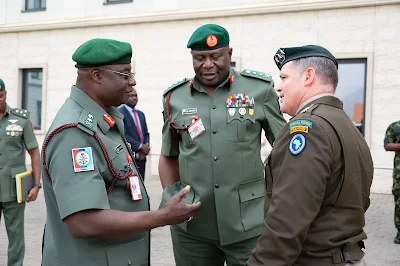
The United States has intensified military assistance to Nigeria, expanding arms deliveries and intelligence sharing as part of a broader campaign against Islamic State-linked militant groups across Africa.
The Deputy Commander of the US Africa Command (AFRICOM), Lt.-Gen. John Brennan, revealed this during an interview with AFP on the sidelines of the inaugural US–Nigeria Joint Working Group security meeting held in Abuja last week.
According to Brennan, Washington has adopted a more aggressive posture under the Trump administration in confronting Islamic State (IS) affiliates operating across the continent.
“Under the Trump administration, we’ve gotten a lot more aggressive and are working with partners to target, kinetically, the threats, mainly ISIS,” he said.
Brennan explained that IS-linked groups across Africa are increasingly interconnected, requiring coordinated responses.
“From Somalia to Nigeria, the problem set is connected. So we’re trying to take it apart and then provide partners with the information they need,” he added.
As part of the renewed cooperation, the US is prioritising intelligence sharing to strengthen Nigerian air operations in both the northwest and northeast, regions long affected by insurgency involving Boko Haram and its offshoot, the Islamic State West Africa Province (ISWAP).
Brennan described ISWAP as “our most concerning group,” noting that American support would focus on enabling Nigerian forces with equipment and operational capabilities under fewer restrictions.
“It’s been about more enabling partners and then providing them equipment and capabilities with less restrictions so that they can be more successful,” he said.
The Joint Working Group meeting followed surprise US air strikes carried out on Christmas Day against IS-linked targets in northwestern Nigeria. The initial strikes reportedly targeted fighters associated with the Islamic State Sahel Province, a group more active in neighbouring Niger.
Despite the strikes, their impact remains uncertain, as journalists have been unable to independently verify militant casualties.
Nigeria’s Minister of Information, Mohammed Idris, said the operation was “still a work in progress.”
The renewed military engagement comes amid diplomatic pressure from Washington over allegations of mass killings of Christians in Nigeria. Nigerian authorities and independent analysts have rejected the narrative, arguing that insecurity affects communities across religious lines.
The issue surfaced during the Abuja meeting when US State Department official Allison Hooker urged Nigeria to protect Christians, without referencing Muslim victims. Brennan, however, stressed that US intelligence support would not be limited to the protection of any single religious group.
Meanwhile, analysts have observed increased US intelligence flights over Nigeria in recent months but have questioned whether air power alone can significantly weaken militant networks operating in regions marked by poverty and limited state presence.
Brennan also warned about the growing threat posed by IS-linked groups spreading from the Sahel into coastal West African countries, including Nigeria.
In addition, he confirmed that the US continues to maintain informal communication with the militaries of Burkina Faso, Mali and Niger, despite the countries being under military rule and having reduced formal cooperation with Western partners.
“We still collaborate,” Brennan said. “We still talk to our military partners across the Sahelian states, even though it’s not official.”
He further clarified that Washington has no plans to establish new military bases in West Africa following the closure of its drone base in Agadez, Niger.
“We’re not in the market to create a drone base anywhere,” Brennan said.
“We are much more focused on getting capability to the right place at the right time and then leaving. We don’t seek long-term basing in any of the West African countries.”