
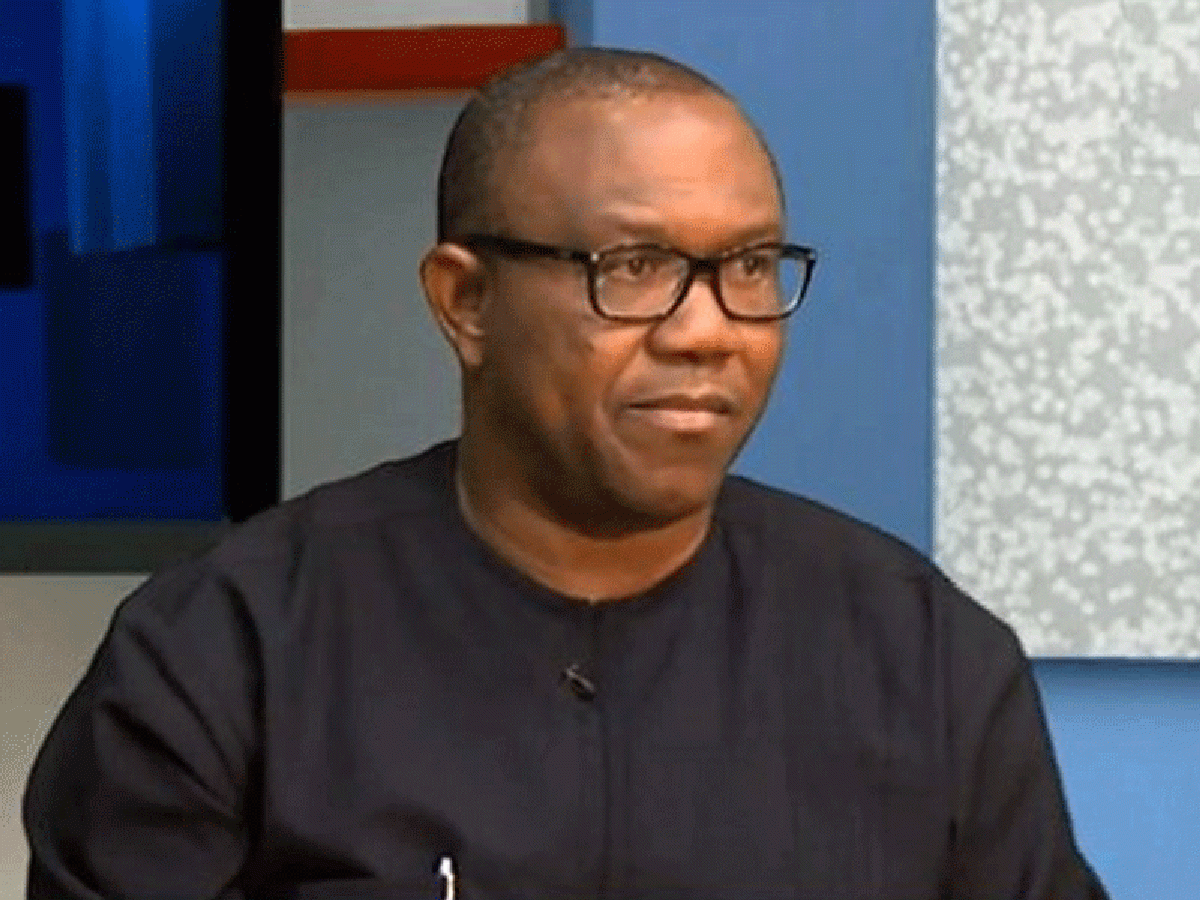
Former Labour Party presidential candidate Peter Obi has disclosed that the proposed coalition between the Labour Party and the African Democratic Congress is encountering significant obstacles due to unresolved disagreements over zoning and rotation of key political positions.
Obi made this known during an interview on Wednesday with ‘Advocacy for Good Governance,’ a YouTube platform, where he outlined his expectations for any political alliance ahead of the 2027 general elections.
The former Anambra State governor, who confirmed his continued membership in the Labour Party, stressed that the coalition must address fundamental issues and establish clear agreements before moving forward.
“Today, I’m a member of the Labour Party, and I subscribe to the coalition, ADC Coalition for the 2027 election. I believe in it. But as much as I believe in it, I need to know the fundamentals that we all agree to respect. What are we going to do for the average Nigerian person?” Obi stated.
He emphasized that members of the coalition remain part of the existing political class and must therefore present new ideas and perspectives to earn public trust.
“We are not different people. We are still part of the political class. So it’s not as if they were a bunch of new people,” he said. “We must come with new ideas that Nigerians will trust. We must come with new things, new perspectives, and we must try to see how we can give Nigeria the alternative that will come with competence, character, capacity, commitment, and compassion.”
While praising coalition leaders including Chairman David Mark and former Vice President Atiku Abubakar, Obi insisted that respect for established protocols and thorough discussions are essential.
“Yes, I respect all those who are leaders there. Of course, our Chairman, David Mark, is one of those people I respect, and I believe he has the political sagacity to lead the party. And so are so many others we have there, people like my own leader, Atiku, somebody for whom I have all my respect and believe in the good of Nigeria,” he said.
“But in all this, there are still some fine lines that we need to respect, where things must be done properly, where we must sit down and talk about where we’re driving the country to.”
Obi revealed that unsigned agreements regarding the presidency and rotation of offices remain major sticking points within the coalition.
“Today, we have what we can call unsigned agreements about the presidency, about rotation of offices. This is why this person will come from here, this person will come from there. All these things need to be organised. The reason why it needs to be organised is that you don’t need to create confusion for the future,” he explained.
The 2023 presidential candidate cautioned against repeating past mistakes, referencing the 2015 election when the opposition successfully removed an incumbent without a clear alternative vision.
“We can’t just say, ‘Oh, we don’t like what these people are doing. Let them go.’ If they go, what is the alternative? We’ve done that in 2015: ‘Let this man just go,’ and he went,” Obi said.
“So we now have to be clear. What are we getting? Can we trust those who are going to drive this vehicle and do what they’re saying? Where have they said it before?”
Obi also clarified his personal priorities, emphasizing his commitment to national progress over individual ambition.
“I am not desperate to become the president of Nigeria. I’m desperate to see Nigeria work. I want to see what it is that they are offering,” he declared.
Despite the current challenges, Obi expressed optimism that the coalition could still succeed if members prioritize the country’s future over personal interests.
“Today, it’s about the future. So if we’re going to do anything, let’s look at the future. Let’s not look at what is going to benefit us,” he urged.
“Even if it takes us one week to agree, we do. If Nigerians want this country to change, we can make a change. It doesn’t matter how. Even if we start three months, six months, eight months, or one year before the election, we can still prepare.”
The Labour Party and African Democratic Congress have been in discussions about forming a coalition ahead of the 2027 elections, positioning themselves as alternatives to the ruling All Progressives Congress and the main opposition Peoples Democratic Party.
However, Obi’s candid remarks suggest that significant work remains to be done before a unified opposition front can be presented to Nigerian voters.
Political observers note that disagreements over zoning and rotation of offices have historically plagued Nigerian political parties and coalitions, often leading to internal conflicts and electoral failures.
As the 2027 elections approach, the ability of opposition parties to resolve these contentious issues may determine their viability as alternatives to the current administration.