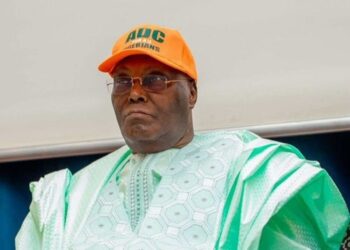

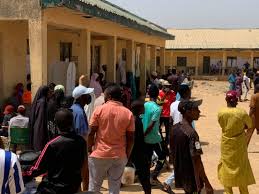
Tension erupted on Saturday at Polling Unit 035 in Nyanya, within the Abuja Municipal Area Council (AMAC) of the Federal Capital Territory, following allegations of vote-buying against the ruling All Progressives Congress (APC).
Agents of the Peoples Democratic Party (PDP) and the African Democratic Congress (ADC) accused APC operatives of attempting to induce voters with cash, triggering a brief disruption at the polling centre.
The situation became heated after opposition party agents confronted individuals they claimed were distributing ₦1,000 to voters waiting in line. The confrontation led to shouting matches among party supporters and temporarily disrupted the voting process.
Security operatives, including personnel of the Nigeria Police Force and the Nigeria Security and Civil Defence Corps, quickly intervened and reinforced their presence at the unit to prevent further escalation.
An opposition party agent, who spoke anonymously, alleged that suspected APC intermediaries moved along the queue offering cash to prospective voters.
“Individuals believed to be APC agents approached people on the queue and offered them ₦1,000. We rejected it openly and challenged them, which led to the unrest. Calm returned after they left the area,” the source claimed.
An ADC representative also criticised security personnel at the scene, alleging inaction.
“They are sharing ₦1,000 per voter and security officers are standing by. This should not be allowed. We will resist any attempt to compromise the process,” the agent said.
At the peak of the tension, one voter appealed to party agents to de-escalate the situation, warning that sustained disorder could result in the cancellation of results at the polling unit.
Voting eventually resumed under heightened security monitoring.
Commercial activities around the polling centre were largely halted due to the election. Most shops remained closed, with only essential services, including Nyanya General Hospital, operating.
Allegations of vote-buying have remained a persistent feature of elections in Nigeria, raising concerns among electoral observers, civil society groups, and the Independent National Electoral Commission (INEC).
Election stakeholders have repeatedly warned that financial inducement compromises the integrity of the ballot and undermines the principle of free and fair elections. Although the Electoral Act criminalises voter inducement and prescribes penalties, enforcement has continued to pose significant challenges.
Analysts attribute the recurring practice to socioeconomic pressures such as poverty and unemployment, as well as gaps in monitoring and enforcement mechanisms. Recent election observation reports have also pointed to evolving tactics, including the use of intermediaries, coded transactions, and electronic transfers conducted near polling centres to avoid detection.