
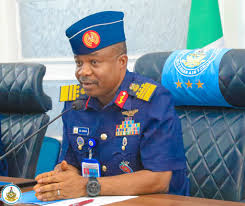
The Chief of the Air Staff (CAS), Air Marshal Hasan Bala Abubakar, has warned that any member of the Armed Forces of Nigeria found culpable in moves to topple the country’s democratic government will be decisively dealt with in accordance with the law.
Air Marshal Abubakar issued the warning on Wednesday during a strategic session with Air Officers Commanding and Unit Commanders at the Nigerian Air Force (NAF) Headquarters in Abuja, marking his first 100 days in office.
He described recent disclosures of an alleged coup plot targeting the administration of President Bola Ahmed Tinubu as disturbing and unacceptable.
The CAS said any attempt to undermine constitutional governance or violently seize power amounts to a betrayal of the military’s oath and core values, stressing that those involved would face legal consequences.
Reaffirming the NAF’s loyalty to democratic rule, Abubakar maintained that the Air Force remains committed to upholding the Constitution and supporting the authority of the duly elected government. He charged commanders to preserve unity, discipline and cohesion within their formations, especially as the country prepares for another electoral cycle.
According to him, the Armed Forces must continue to operate with professionalism and neutrality, providing support to civil authorities and safeguarding democratic institutions without partisan bias.
Security reports had indicated that over 40 military personnel and civilians were arrested over an alleged coup plot uncovered in October last year. While investigations are ongoing, relatives of some of the suspects have appealed for clemency and due process.
Reviewing his first three months in office, the Air Chief said he had conducted operational tours across various commands to evaluate activities and interact directly with personnel, with a view to strengthening efficiency and morale.
He noted that Nigeria’s security landscape is being shaped by broader global and regional developments, including intensifying geopolitical rivalries, shifting alliances and growing instability in the Sahel.
Abubakar expressed particular concern over the security situation in Mali, Burkina Faso and Niger, warning that the spread of extremist groups affiliated with Islamic State and al-Qaeda poses significant risks to Nigeria and other coastal West African countries.
He further described reports of Islamic State West Africa Province (ISWAP) expanding operations into Kwara State as troubling, calling for firm and coordinated countermeasures.
On the domestic front, however, the CAS pointed to gradual improvements in certain areas. He cited a decline in pipeline vandalism in the Niger Delta and enhanced stability in the South-East, where joint security operations have reduced separatist violence and weakened enforcement of sit-at-home directives.
He added that sustained security interventions in the Niger Delta have contributed to a rise in crude oil production to approximately 2.2 million barrels per day, though he cautioned that criminal activities targeting oil infrastructure remain a persistent challenge.