
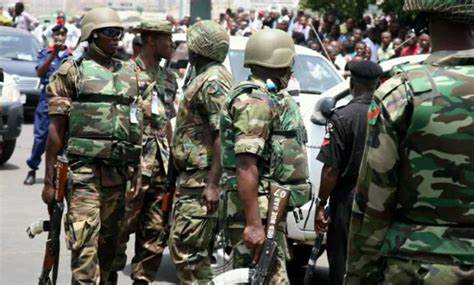
The Nigerian military has intensified intelligence and surveillance operations to track suspected Boko Haram and Islamic State West Africa Province (ISWAP) fighters believed to be fleeing their hideouts following recent United States airstrikes in parts of north-western Nigeria.
The development followed an announcement by U.S. President Donald Trump on Christmas Day that American forces had carried out lethal strikes on Islamic State targets in Nigeria. The Federal Government later confirmed the operation, describing it as part of ongoing counterterrorism cooperation between Nigeria and the United States.
In the days after the air raids, reports emerged of unusual movement by armed groups into neighbouring communities and forest corridors. The Chairman of the Traditional Council in Gwer West Local Government Area of Benue State, Daniel Abomtse, expressed concern over what he described as an influx of armed herders into some local communities shortly after the strikes.
Similar concerns were raised by community leaders in Tangaza and Gudu local government areas, as well as parts of Illela in Sokoto State. Residents in the affected areas reported seeing suspected fighters moving in smaller groups toward remote forest routes, with some believed to be attempting to cross into nearby border communities.
Senior military officials, who spoke on Monday, confirmed that the armed forces were aware of the developments and were closely monitoring the situation. One official said security agencies had credible information on the movements of fleeing militants and were tracking them. Another source disclosed that ongoing intelligence, surveillance and reconnaissance (ISR) operations were being deployed to monitor and respond to the threat.
Meanwhile, the reported airstrikes have reignited debate over the extent of United States involvement in Nigeria’s counter-insurgency efforts. The Minister of Foreign Affairs, Yusuf Tuggar, recently said the Ministry of Defence would advise the Federal Government on possible next steps when asked whether Nigeria might consider allowing U.S. troops into the country.
Retired senior military officers, however, have expressed divergent views on the issue. A former senior officer, Brigadier-General Peter Aro (retd.), warned against the deployment of U.S. soldiers on Nigerian soil, citing potential legal, diplomatic and social consequences. He argued that foreign troops could only be deployed under a formal defence pact approved at the highest levels of government and cautioned that such a move could deepen internal mistrust and fuel insurgent propaganda.
According to Aro, Nigeria already has sufficient ground forces, including the armed forces, police and civil defence units, and should instead seek support in areas such as air power, surveillance and precision strike capabilities, where the U.S. has comparative advantage.
In contrast, another retired officer, Brigadier-General Bashir Adewinbi (retd.), supported closer security collaboration with the United States, describing international cooperation as a normal practice. He linked the Christmas Day strike to ongoing Nigeria-U.S. security engagements and said that if the deployment of U.S. troops became necessary, it should follow due diplomatic processes with clearly defined terms of engagement.
Adewinbi maintained that such cooperation would not undermine the morale of Nigerian troops, stressing that international partnerships were aimed at achieving results in the fight against insecurity.
Also commenting, Major-General Dayo Olukoju (retd.) urged caution, noting that security decisions must be carefully weighed to avoid strategic errors.
A former spokesman of the Nigerian Air Force, Group Captain Sadique Shehu (retd.), criticised suggestions that U.S. soldiers should be deployed to Nigeria, describing the idea as troubling. He said Nigeria could benefit from foreign technology and advisory support but should not rely on foreign troops to fight on its soil.
Shehu also noted that there was no confirmed information on whether terrorists were killed during the reported airstrikes, adding that Nigeria should clearly define and communicate the terms of any foreign security assistance to its citizens. He stressed that Nigerian authorities, rather than foreign governments, should take the lead in informing the public about security operations within the country.
As military operations continue, security agencies say efforts are ongoing to prevent fleeing militants from regrouping or spreading violence into new areas, while the debate over foreign military involvement remains unresolved.