
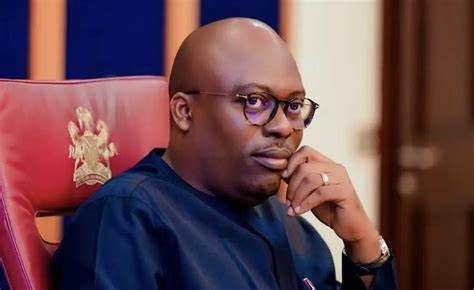
Rivers State Governor Siminalayi Fubara has emphatically rejected media reports suggesting a breakdown in relations between him and members of both the national and state assemblies, describing such claims as entirely false.
The Governor made the strong denial on Wednesday, December 10, during the commissioning ceremony of the extended and dualised 28.4-kilometre Ahoada–Omoku Road, a major infrastructure project in the state.
His comments come just one day after the surprise announcement of his defection from the Peoples Democratic Party to the All Progressives Congress, a move that has sent shockwaves through Rivers State’s political landscape.
Addressing persistent rumors that he had deliberately avoided engaging with legislators or refused to address their concerns, Governor Fubara insisted he had made “every effort” to convene a meeting with the lawmakers.
However, the Governor clarified that the responsibility for scheduling and facilitating such a meeting did not rest solely with him, pointing instead to his predecessor and current Minister of the Federal Capital Territory, Nyesom Wike, along with other influential political leaders in the state.
Fubara’s statement appears designed to counter narratives portraying him as dismissive of legislative input or unwilling to engage in dialogue with elected representatives.
The denial also suggests that the Governor is attempting to shift responsibility for any communication breakdown onto other political actors, particularly Wike, with whom he has been embroiled in a protracted and highly public political conflict.
The relationship between Fubara and Wike, who handpicked him as his successor, has deteriorated dramatically since the Governor assumed office, with disputes over political control, appointments, and state resources dominating headlines.
The feud has divided the Rivers State House of Assembly, with some members loyal to Wike attempting to impeach Fubara last year before President Bola Tinubu intervened to broker a fragile peace agreement.
That agreement, which included provisions for political reconciliation and power-sharing arrangements, appears to have collapsed entirely with Fubara’s recent defection to the APC.
By joining the ruling party, Fubara has aligned himself with President Tinubu and distanced himself further from Wike and the PDP structure that brought him to power.
The defection has raised questions about the Governor’s political calculations and whether he has secured guarantees of support from national APC leadership in his ongoing battle with Wike for control of Rivers State’s political machinery.
Political observers note that Fubara’s move to the APC could complicate Wike’s position, as the FCT Minister remains officially a PDP member despite his close working relationship with President Tinubu and alleged role in undermining PDP interests.
The commissioning of the Ahoada–Omoku Road, which the Governor used as a platform to address the rumors, represents a significant infrastructure achievement and an opportunity for Fubara to demonstrate his administration’s commitment to development despite political distractions.
The 28.4-kilometre road connects two major towns in the Orashi region of Rivers State and is expected to improve transportation, boost economic activity, and enhance access to communities that have long suffered from poor road infrastructure.
By highlighting tangible projects like the road expansion and dualization, Fubara appears to be positioning himself as a results-oriented leader focused on governance rather than political squabbles.
Several Rivers State House of Assembly members aligned with Wike have publicly accused Fubara of sidelining the legislature, refusing to implement budgetary allocations, and operating outside constitutional frameworks.
The Governor’s assertion that meeting arrangements were the responsibility of Wike and other leaders suggests ongoing disputes over protocol, political hierarchy, and who wields ultimate authority in Rivers State’s complex power dynamics.
As Rivers State navigates this turbulent political period, with the governor now in a different party from the one that elected him, questions persist about governance stability, legislative functionality, and whether genuine reconciliation remains possible.
Fubara’s denial of strained legislative relations may represent an attempt to control the narrative and project an image of normalcy, even as his political realignment signals a fundamental rupture in the state’s established power structures.
The coming weeks will reveal whether the Governor’s defection to the APC and his public statements denying conflict with lawmakers mark a new chapter of political stability or simply add another layer of complexity to Rivers State’s ongoing political crisis.