
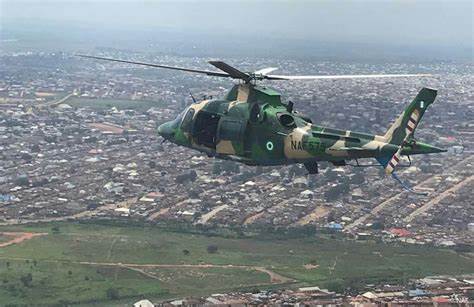
Nigeria has recalled the fighter aircraft it deployed to the Benin Republic following assessments that the security situation in the neighboring nation has stabilized after Sunday’s abortive military coup attempt.
According to security analyst Zagazola Makama, the aircraft, which had been dispatched from Lagos for surveillance and regional security monitoring, received orders to return to base on Sunday afternoon after updated intelligence confirmed the crisis had been contained.
The withdrawal decision came after Nigerian authorities determined there was “no immediate threat to Nigeria’s territorial security” following the collapse of the coup attempt against President Patrice Talon’s government.
The dramatic events in Benin Republic began in the early hours of Sunday when mutineers dressed in military uniforms launched an operation aimed at overthrowing the democratically elected government.
The insurgents’ initial target was President Talon’s residence in Cotonou, the economic capital, but loyalist forces successfully repelled the assault on the presidential compound.
After failing to capture the seat of power, the rebel faction redirected their efforts toward the state-run Office de Radiodiffusion et Télévision du Bénin (ORTB), seizing control of the national broadcaster and its transmission signal.
The takeover of the television station briefly gave the mutineers a platform to potentially address the nation, though no such broadcast was reported.
However, the government’s response proved swift and decisive. Units of the National Guard and loyal armed forces quickly mobilized, encircling the television station and cutting off the mutineers from potential reinforcements.
By late Sunday evening, security forces had successfully secured all key government installations and established firm control over Cotonou.
A senior security official, speaking on condition of anonymity due to the operational sensitivity, confirmed the restoration of government authority.
“The situation is under control. The National Guard has everything surrounded,” the official stated.
According to local media outlet 24 Hours In Benin, the mutineers remained barricaded inside the television station as of Sunday evening, with authorities engaged in negotiations to secure their peaceful surrender without further bloodshed.
President Patrice Talon, who was relocated to an undisclosed secure location during the crisis, has not yet issued a public statement addressing the attempted overthrow or reassuring the nation.
Initial reports suggest that Cotonou remained tense but relatively calm following the failed coup attempt, with no confirmation of widespread violence or significant casualties in the streets.
The Beninese government is expected to release a comprehensive statement in the coming hours, providing additional details about the incident and disclosing the identities of those involved in the mutiny.
The swift collapse of the coup attempt demonstrates the loyalty of Benin’s security forces to constitutional authority and may deter future destabilization efforts in a region that has witnessed multiple successful military takeovers in recent years.
Nigeria’s rapid deployment and subsequent withdrawal of surveillance aircraft reflects the country’s heightened sensitivity to political instability along its borders, particularly given the porous nature of the Nigeria-Benin frontier and the potential for security threats to spill across international boundaries.
The failed coup in Benin comes just days after Nigeria granted asylum to Guinea-Bissau opposition candidate Fernando Dias da Costa following a successful military coup in that country, highlighting the ongoing vulnerability of democratic institutions across West Africa.
President Talon, who has governed Benin since 2016 and secured re-election in 2021, has faced criticism from opposition groups and international observers over allegations of authoritarian governance and the suppression of political dissent.
However, the failure of Sunday’s coup attempt suggests that despite political tensions, the country’s military and security establishment remain largely committed to constitutional order.
The Economic Community of West African States (ECOWAS), which has been grappling with a series of military takeovers across the region, has not yet issued an official statement on the attempted coup in Benin Republic.
As stability returns to Cotonou, attention will now shift to the government’s handling of those involved in the mutiny and whether President Talon will use the incident to further consolidate power or pursue national reconciliation efforts.