
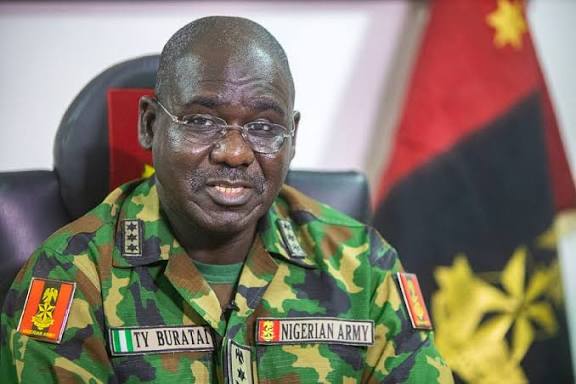
Former Chief of Army Staff and current Nigerian Ambassador to the Benin Republic, Lt. General Tukur Buratai (rtd), has vehemently rejected allegations linking him to terrorism financing, describing the claims as fabricated and malicious.
General Buratai issued the denial on Saturday through a statement signed by former Army spokesperson, Brigadier General Sani Kukasheka Usman, in response to an online publication by Sahara Reporters that named him among prominent figures allegedly connected to terrorism financiers.
The statement characterized the accusations as baseless and part of a calculated smear campaign designed to damage the former Army chief’s reputation, emphasizing that he has never been questioned or investigated regarding terrorism financing throughout his distinguished military career.
“At no point in his distinguished career has he ever been questioned, investigated, indicted, or associated with any such matter by any official body or authority,” the statement read.
“No security institution, intelligence agency, judicial panel, diplomatic mission, oversight mechanism, or administrative body has ever linked him with terrorism financing in any form.”
General Buratai dismissed the allegations as entirely dependent on unverified personal claims made by retired Major General Danjuma Ali-Keffi in the Sahara Reporters article, describing the publication as driven by malice rather than factual evidence.
The former Army chief’s statement accused the online platform of waging a long-running campaign to discredit his reputation, noting that previous attempts had failed due to his transparent and honorable record of service to Nigeria.
“Each attempt has failed because his record remains forthright, transparent, and distinguished by honourable service to the nation,” the statement noted.
The response highlighted Buratai’s more than four decades of military service, during which he demonstrated “honour, courage, and steadfast commitment” to defeating terrorism in Nigeria.
The statement specifically referenced his leadership during counter-insurgency operations against Boko Haram and the Islamic State West Africa Province (ISWAP), where the Nigerian Army achieved significant successes including territorial recovery, restoration of civil administration, and resettlement of displaced persons.
“It defies logic and conscience to suggest that the same person who led decisive actions against terrorism would in any way be associated with the very elements he spent his career confronting,” the statement declared.
General Buratai’s legal team has demanded that Sahara Reporters and Major General Ali-Keffi immediately retract the allegations and issue a public apology to the former Army chief.
The statement warned that failure to comply with the demand would compel Buratai to pursue legal remedies to protect his reputation and seek redress for what he describes as a malicious attack on his character.
“Failure to do so will leave us with no option but to initiate appropriate legal proceedings to protect his reputation and seek redress for this malicious attack,” the statement said.
The controversy emerges at a time when Nigeria’s security establishment faces intense scrutiny over the country’s persistent terrorism challenges, despite years of military operations in the Northeast and other affected regions.
General Buratai served as Chief of Army Staff from July 2015 to January 2021, overseeing military operations during a critical period in Nigeria’s fight against Boko Haram insurgency. He was subsequently appointed as Ambassador to the Benin Republic by President Muhammadu Buhari.
Throughout his tenure as Army chief, Buratai was a polarizing figure, praised by some for his operational leadership while criticized by others over allegations of human rights violations by troops under his command—charges he consistently denied.
As of press time, neither Sahara Reporters nor Major General Ali-Keffi had issued public responses to Buratai’s demands for retraction and apology.