
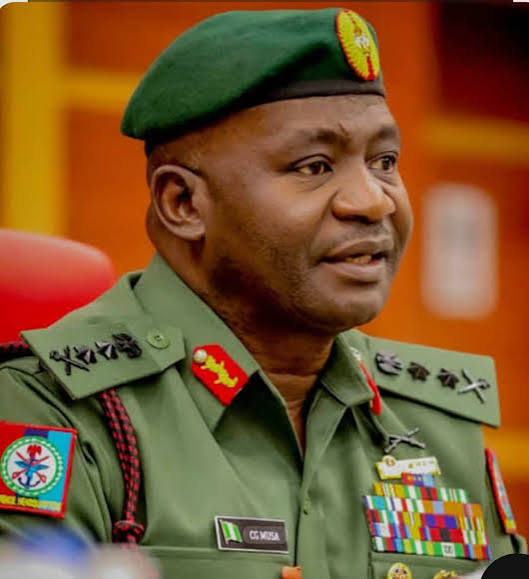
Newly appointed Minister of Defence, General Christopher Musa (retd.), on Friday formally took charge at the Ministry of Defence headquarters in Ship House, Abuja, promising Nigerians that the government’s renewed security strategies will yield tangible results within the shortest possible time.
General Musa, whose appointment was confirmed by the Senate on Thursday following his nomination by President Bola Tinubu, arrived at the ministry at approximately 11:10 a.m., where he was accorded full military honours and inspected the quarter guard in accordance with protocol.
The former Chief of Defence Staff immediately convened a closed-door meeting with service chiefs and the ministry’s directors to discuss the nation’s security architecture and operational priorities.
His appointment follows the resignation of former Defence Minister Muhammed Badaru, who stepped down earlier this week citing health reasons.
Shortly after taking the oath of office administered by President Tinubu at the Presidential Villa on Thursday, General Musa outlined his vision for transforming Nigeria’s security landscape through enhanced coordination and institutional reform.
“My immediate priority is to make sure that defence takes its place fully in the country,” Musa told journalists after the swearing-in ceremony.
The new minister emphasized that overhauling the nation’s defence structure and fostering stronger collaboration among all security agencies would be central to his approach.
General Musa stressed the critical importance of synergy within the armed forces and between military and civilian security outfits, noting that collective responsibility is essential to addressing Nigeria’s complex security challenges.
“It is that synergy that we need to build on and work on, and that’s what we are going to do,” he said, adding that “security is everybody’s responsibility.”
The Defence Minister expressed confidence that improved coordination and cooperation among security agencies would accelerate the resolution of insecurity plaguing various regions of the country.
“I can assure you, within the shortest possible time, Nigerians will see results,” General Musa declared.
His assumption of office comes at a critical juncture for Nigeria’s security sector, with the country grappling with multiple threats including terrorism in the Northeast, banditry in the Northwest, separatist agitation in the Southeast, maritime piracy in coastal areas, and widespread kidnapping across several states.
During his Senate screening on Wednesday, General Musa had outlined a comprehensive reform agenda that includes banning ransom payments to terrorists, establishing special courts for terrorism cases, creating a unified national database for security coordination, reducing military checkpoints to free up troops for field operations, and prohibiting illegal mining that funds criminal groups.
His appointment represents a rare transition from military service chief to civilian cabinet minister, bringing direct operational experience to the Defence Ministry’s oversight role.
As General Musa settles into his new position, Nigerians await the implementation of his promised reforms and the delivery of measurable improvements in national security within the timeframe he has pledged.