
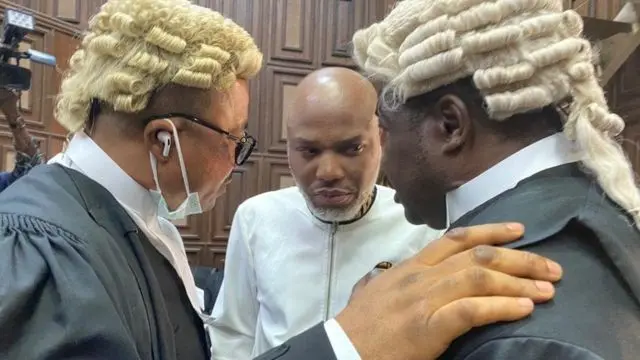
The detained leader of the Indigenous People of Biafra, Mazi Nnamdi Kanu, arrived at the Federal High Court in Abuja on Thursday for what was scheduled as judgment day in his long-running terrorism trial, but immediately declared that no verdict would be delivered because of fresh legal processes he has filed.
Speaking in court moments after his arrival, Kanu made the bold assertion that the proceedings could not move forward to judgment despite Justice James Omotosho having previously fixed Thursday, November 20, as the date for delivering a ruling in the case.
“There is no judgment as I have filed my processes,” Kanu stated, signaling his intention to block the court from proceeding with the scheduled verdict. According to the separatist leader, “no judgement would hold” in light of the new applications his legal team has submitted.
Justice Omotosho is expected to rule on several competing applications filed by both the defense and prosecution, including Kanu’s fundamental challenge to the legal basis of the terrorism charges against him and his demand for immediate release on grounds of alleged unlawful detention and violation of his constitutional rights.
The IPOB leader has been in custody of the Department of State Services since June 2021 following what his lawyers have consistently characterized as “extraordinary rendition” from Kenya, a characterization that forms part of his defense strategy claiming the court lacks jurisdiction due to the allegedly illegal manner in which he was brought back to Nigeria.
Kanu faces seven terrorism-related charges encompassing allegations of incitement, running an unlawful organization, and engaging in actions deemed threatening to national security—accusations he has vigorously denied throughout the protracted legal battle.
In a fresh motion that appears designed to halt Thursday’s proceedings, the separatist leader mounted a technical legal argument claiming that the Terrorism Prevention and Prohibition Act under which he is being prosecuted has been repealed by subsequent legislation.
Based on this premise, Kanu urged the court to strike out all charges against him, arguing that they “disclosed no offence known to law” and should therefore be declared a nullity since they allegedly reference obsolete legal provisions.
Taking his challenge further, the IPOB leader requested that the court expunge what he termed the “purported plea of not guilty” that was entered on his behalf, claiming it was obtained through deception and in direct defiance of a Supreme Court ruling that he believes should have resulted in his unconditional release.
Kanu also sought an order setting aside all proceedings that have taken place subsequent to what he considers the court’s failure to properly apply Supreme Court directives, and demanded an order directing his immediate and unconditional release from detention.
The dramatic courtroom moment comes after Justice Omotosho had previously fixed November 20 for judgment following Kanu’s failure to present his defense despite being granted six days to do so. The judge had ruled that having been afforded adequate opportunity to conduct his defense but failing to utilize it, Kanu could not subsequently claim denial of his constitutional right to fair hearing.
However, rather than accepting that judgment would proceed, Kanu’s legal team has filed what appears to be a stay of proceedings application with the Court of Appeal, seeking to halt the Federal High Court from delivering its verdict pending the determination of fundamental questions about the validity of the charges and the court’s jurisdiction.
Whether Justice Omotosho will accept Kanu’s assertion that “no judgment” can be delivered, or will proceed to rule on the substantive terrorism charges despite the fresh applications, will become clear as Thursday’s proceedings unfold.
The packed courtroom and heavy security presence underscore the continued sensitivity of the case, which has become a flashpoint for tensions between the Federal Government and separatist agitators in Nigeria’s Southeast region.
Kanu’s supporters, who maintain that he is a political prisoner being persecuted for championing Biafran independence, have long called for his release and a political rather than judicial solution to the underlying grievances driving separatist sentiment.
However, the Federal Government has insisted that Kanu must face trial for alleged criminal activities undertaken in pursuit of his separatist agenda, including broadcasts and statements authorities claim incited violence and threatened national unity.
As both sides await Justice Omotosho’s decision on how to proceed in light of the fresh applications, the question remains whether Thursday will mark the conclusion of Kanu’s trial or merely another chapter in a legal saga that has already stretched over four years since his controversial repatriation to Nigeria.